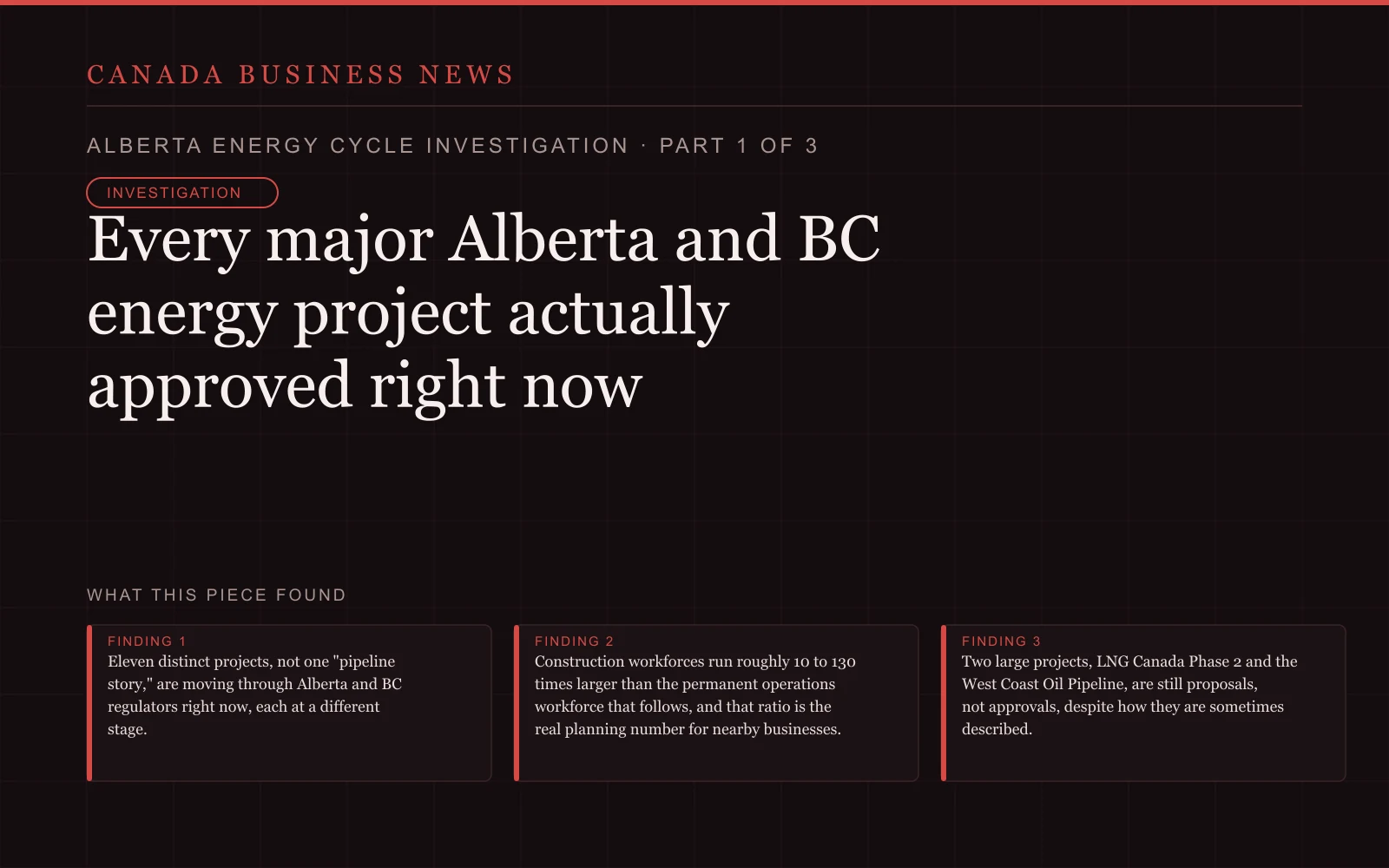
"A pipeline got approved" is not one event. As of August 2026, eleven distinct energy infrastructure projects touching Alberta and British Columbia are sitting at eleven different points in the regulatory and construction pipeline, from fully operational to merely referred for review. Treating them as a single story, a single jobs number, or a single moment of local opportunity is the first mistake a small-business owner near any of these corridors can make.
This is a register, built entirely from regulator and government project pages: the Canada Energy Regulator, the BC Environmental Assessment Office, the Alberta Utilities Commission, and Natural Resources Canada. Where a figure could not be independently confirmed from one of those sources, it is marked as such rather than reported as fact.
What's actually in service
Three projects are complete and operating. The Trans Mountain Expansion went into commercial service in May 2024, tripling the system's capacity from 300,000 to 890,000 barrels a day between Edmonton and Burnaby at a final cost of $34.2 billion, according to the Parliamentary Budget Officer's 2024 review. Coastal GasLink began moving gas from the Dawson Creek area to Kitimat in December 2023. LNG Canada's first Phase 1 train shipped its first cargo in June 2025, with a second train following in November 2025, bringing 14 million tonnes a year of export capacity online at Kitimat.
Even the government's own workforce figures for these projects don't always agree with each other. Trans Mountain's peak construction headcount has been reported anywhere from about 5,500 to nearly 16,000 depending on the release date and measurement window, and no single authoritative figure resolves that range. That inconsistency is itself worth knowing: even a $34-billion federally regulated project doesn't produce one clean, final jobs number that a nearby business can plan a season around.
What's actually approved, right now
Every major Alberta/BC energy infrastructure project with a formal regulatory decision, ordered by approval date. Colour marks current status, not project size.
Source: Canada Energy Regulator, BC Environmental Assessment Office, Alberta Utilities Commission, Natural Resources Canada
The construction-to-operations cliff
The single number that matters most to a small business near one of these projects is not the construction jobs figure. It's the ratio between that figure and what follows it.
LNG Canada's own government-cited numbers show the shape clearly: up to 10,000 construction jobs at the BC government's own estimate, against 950 permanent operations positions once the plant is running. That's roughly a 10.5-to-1 drop. Coastal GasLink's numbers are harder to compare directly, since the BC government reported construction in person-years (11,000 direct plus 8,900 indirect person-years, a measure of cumulative effort rather than peak headcount) against roughly 150 direct-and-indirect operations jobs, but even a conservative reading puts that ratio well above 70-to-1.
This is the mechanism behind every boomtown story that ends badly for local business: the town that can support a construction-camp economy, extra restaurant seats, extra hotel rooms, extra trades demand, is not the town that can support what's left once the camp empties. A business that leases more space, hires more staff, or takes on debt sized to the construction-phase population is planning around a number that is, by design, temporary.
The construction-to-operations cliff
Government-cited workforce estimates for the two largest completed BC LNG-era projects. Construction figures are peak or cumulative program estimates, not identical concepts across projects; treat the ratio as illustrative of scale, not a precise multiplier.
Source: BC government project pages (LNG Canada, Coastal GasLink)
Under construction now
Two projects are actively being built. Cedar LNG, at Kitimat on Haisla Nation land (50.1 percent Haisla-owned, 49.9 percent Pembina), received its provincial certificate in March 2023 and its federal decision statement in May 2023, with a floating, electrified facility targeting roughly 3 to 3.3 million tonnes a year of capacity. Woodfibre LNG, near Squamish, holds a certificate first issued in 2015 and amended repeatedly since, most recently in November 2025 to add floating workforce accommodation. Neither project's government filings disclose a peak construction headcount; industry estimates exist but are not used here because they don't meet this publication's sourcing standard.
Both are worth watching specifically because they are smaller than LNG Canada and Coastal GasLink. A construction program in the hundreds to low thousands of workers, rather than tens of thousands, changes the calculus for nearby small businesses: less overwhelming demand, but also a shorter runway to build the kind of vendor relationship that survives past the construction phase.
Approved, not yet built
Two projects have cleared their regulator but haven't broken ground as of this writing. The Taylor to Gordondale Pipeline, an 88-kilometre, 16-inch line carrying crude oil and natural gas liquids from BC's Montney formation into Alberta, received its Canada Energy Regulator certificate in February 2026 at a cost of $340.9 million. The Yellowhead Pipeline, a 235-kilometre, 36-inch gas line from the Peers area to Fort Saskatchewan, cleared the Alberta Utilities Commission in July 2026 at $2.9 billion, with the AUC citing roughly 2,000 direct construction jobs.
Approval is not construction. Both projects still have to finalize contractors, mobilize crews, and set an actual construction calendar, which is the information a nearby business actually needs before making a hiring or lease decision, and which is not yet public for either project.
Recommended and proposed: read the fine print
Three items in this register are routinely described in casual conversation as "approved" when the government record says otherwise, and the distinction matters enormously for planning purposes.
The Westcoast Energy Sunrise Expansion Program, a 42-inch line from Chetwynd, BC to the US border near Sumas and Abbotsford, received a Canada Energy Regulator Commission recommendation in January 2026. A recommendation is not a Governor in Council decision, and this investigation found no confirmation that the final federal decision has actually been issued. LNG Canada's Phase 2, which would double the Kitimat facility's capacity to 28 million tonnes a year, has not been sanctioned; a federal-provincial cooperation agreement reached in May 2026 aims toward a possible Final Investment Decision later in 2026, which is a step toward a decision, not the decision itself.
The West Coast Oil Pipeline, a proposed roughly 1-million-barrel-a-day heavy crude line from Alberta to BC's west coast, was referred to the federal Major Projects Office in July 2026 for potential designation as a national-interest project. Government-cited figures put its peak construction employment at around 140,000 and its ongoing operations employment at around 50,000 a year, including 7,500 outside Alberta, but this investigation could only moderately confirm those figures (a direct government-page fetch returned an access error) and the project itself has not been approved by any regulator. Reporting a peak construction figure of 140,000 jobs as though the project were built would be exactly the kind of promotional error this publication's sourcing rules exist to prevent.
The full register
Every figure below traces to the government source cited in the paragraphs above, or the sources block at the bottom of this page. "Not published" means no government-sourced figure was found, not that the figure is zero.
The full register, project by project
Every figure traces to the regulator or government page named in this article's sources. “Not published” means no government-sourced figure was found, not that the value is zero.
| Project | Status | Capacity | Cost | Construction jobs | Operations jobs | Region |
|---|---|---|---|---|---|---|
| Trans Mountain Expansion (TMX) | In service | 300,000 to 890,000 bbl/d (+590,000 bbl/d) | $34.2 billion (final estimate, Parliamentary Budget Officer) | Peak workforce reported inconsistently across official releases, from about 5,500 to nearly 16,000 depending on date and source; no single authoritative figure | About 440 long-term direct jobs (federal estimate) | Edmonton, AB to Burnaby, BC |
| Coastal GasLink Pipeline | In service | 2.0 to 2.1 Bcf/d, expandable to 5 Bcf/d | $4.7 billion (2014 approved estimate; actual final cost not confirmed in a government source) | About 11,000 direct plus 8,900 indirect person-years (BC government estimate, cumulative not peak headcount) | About 150 direct and indirect combined (BC government estimate) | Dawson Creek area to Kitimat, BC |
| LNG Canada, Phase 1 | In service | 14 million tonnes per year (two trains) | $24 billion in direct private-sector investment (BC government) | Up to 10,000 (BC government estimate) | 950 permanent positions (BC government) | Kitimat, BC |
| LNG Canada, Phase 2 | Proposed | Would double total capacity to 28 million tonnes per year | Estimated $33 billion in additional private capital if sanctioned | Not yet published | Not yet published | Kitimat, BC |
| Cedar LNG | Under construction | About 3.0 to 3.3 million tonnes per year, floating and electrified | Not published in a government source | Not published in a government source (industry estimates only) | Not published in a government source; accommodation filings imply a workforce above 160 | Kitimat, BC (Haisla Nation land, 50.1% Haisla / 49.9% Pembina) |
| Woodfibre LNG | Under construction | 2.1 million tonnes per year | Not published in a government source | Not published in a government source (industry estimates only) | Not published in a government source | Squamish, BC |
| NGTL System expansions (four CER-approved projects) | In service | 1.45 Bcf/d incremental (largest single project, the 2021 NGTL Expansion) | $2.3 billion, $509 million, $632 million, and $355.5 million across the four projects | 1,740 direct FTE construction jobs cited for the North Corridor project alone (federal estimate) | Not published as a separate figure | Northern, central, and southwestern Alberta |
| Taylor to Gordondale Pipeline | Approved, not yet built | 16-inch pipeline, crude oil and NGLs from the Montney formation | $340.9 million | Not published | Not published | Taylor, BC to Gordondale, AB |
| Yellowhead Pipeline | Approved, not yet built | 36-inch pipeline, more than 1.1 Bcf/d added capacity | $2.9 billion | About 2,000 direct construction jobs (AUC-cited estimate) | Not published | Peers area to Fort Saskatchewan, AB |
| Westcoast Energy Sunrise Expansion Program | Recommended, pending final decision | 42-inch pipeline, 11 compressor loops | Not published | Not published | Not published | Chetwynd, BC to the US border near Sumas/Abbotsford |
| West Coast Oil Pipeline | Proposed | About 1 million bbl/d heavy crude, Alberta to BC's west coast | Not published | About 140,000 at peak (government-cited estimate, moderately confirmed, treat as preliminary) | About 50,000 per year once in service, including 7,500 outside Alberta (government-cited estimate, moderately confirmed) | Alberta to BC west coast |
What this means for nearby small business
None of this is an argument against these projects, or against the real, substantial local opportunity they represent. It's an argument for reading the regulatory status and the workforce ratio before making a business decision sized to a construction-phase population.
The next two pieces in this investigation build directly on this register. The second examines four decades of Alberta oil price cycles against real unemployment, business insolvency, and migration data, including a finding that complicates the simple "oil crashes, small business suffers" story most owners assume is true. The third turns both into a practical preparation framework: how to capture a construction-phase windfall without structuring the business around a population that, on this register's own numbers, is scheduled to shrink 10-to-1 or more once the operations phase begins.
Government links used for this briefing
These links point to federal, provincial, territorial, municipal, intergovernmental, or official data sources. Readers should confirm current eligibility and deadlines directly with the issuing government before applying.
Official regulator project page for approval date, in-service date, and route.
Federal / EvidencePipeline Profile: Trans Mountain Expanded SystemCanada Energy RegulatorOfficial capacity figures before and after expansion.
Federal / EvidenceTrans Mountain Pipeline 2024 reportOffice of the Parliamentary Budget OfficerIndependent federal costing office's final project cost estimate.
Provincial / EvidenceCoastal GasLink environmental assessment certificateGovernment of British ColumbiaOfficial approval release with cost, employment, and route conditions.
Provincial / EvidenceLNG Canada project pageGovernment of British ColumbiaOfficial capacity, investment, and workforce figures for LNG Canada Phase 1.
Federal / EvidenceCanadian LNG projectsNatural Resources CanadaFederal registry of LNG project capacities including Cedar LNG and Woodfibre LNG.
Federal / EvidenceEnhanced investment co-operation advances LNG Canada Phase 2Natural Resources CanadaOfficial confirmation Phase 2 is not yet sanctioned.
Provincial / EvidenceCedar LNG environmental assessment certificateGovernment of British ColumbiaOfficial provincial approval for Cedar LNG.
Federal / EvidenceCedar LNG project registryImpact Assessment Agency of CanadaOfficial federal decision statement and project details.
Provincial / EvidenceWoodfibre LNG floating accommodation amendmentGovernment of British ColumbiaMost recent official amendment to the Woodfibre LNG certificate.
Federal / EvidencePipeline Profile: NGTL SystemCanada Energy RegulatorOfficial cost and capacity figures for NGTL System expansion projects.
Federal / EvidenceGovernment of Canada approves the NGTL 2023 North Corridor System Expansion ProjectNatural Resources CanadaOfficial construction jobs and labour income estimate.
Federal / EvidenceTaylor to Gordondale Pipeline ProjectCanada Energy RegulatorOfficial February 2026 certificate and project cost.
Provincial / EvidenceYellowhead Pipeline ProjectAlberta Utilities CommissionOfficial July 2026 decision, cost, and construction jobs estimate.
Federal / EvidenceWestcoast Energy Sunrise Expansion ProgramCanada Energy RegulatorOfficial record confirming Commission recommendation status, not yet a final decision.
Federal / EvidenceMajor Projects Office: West CoastPrivy Council OfficeOfficial federal listing of the proposed West Coast Oil Pipeline referral.