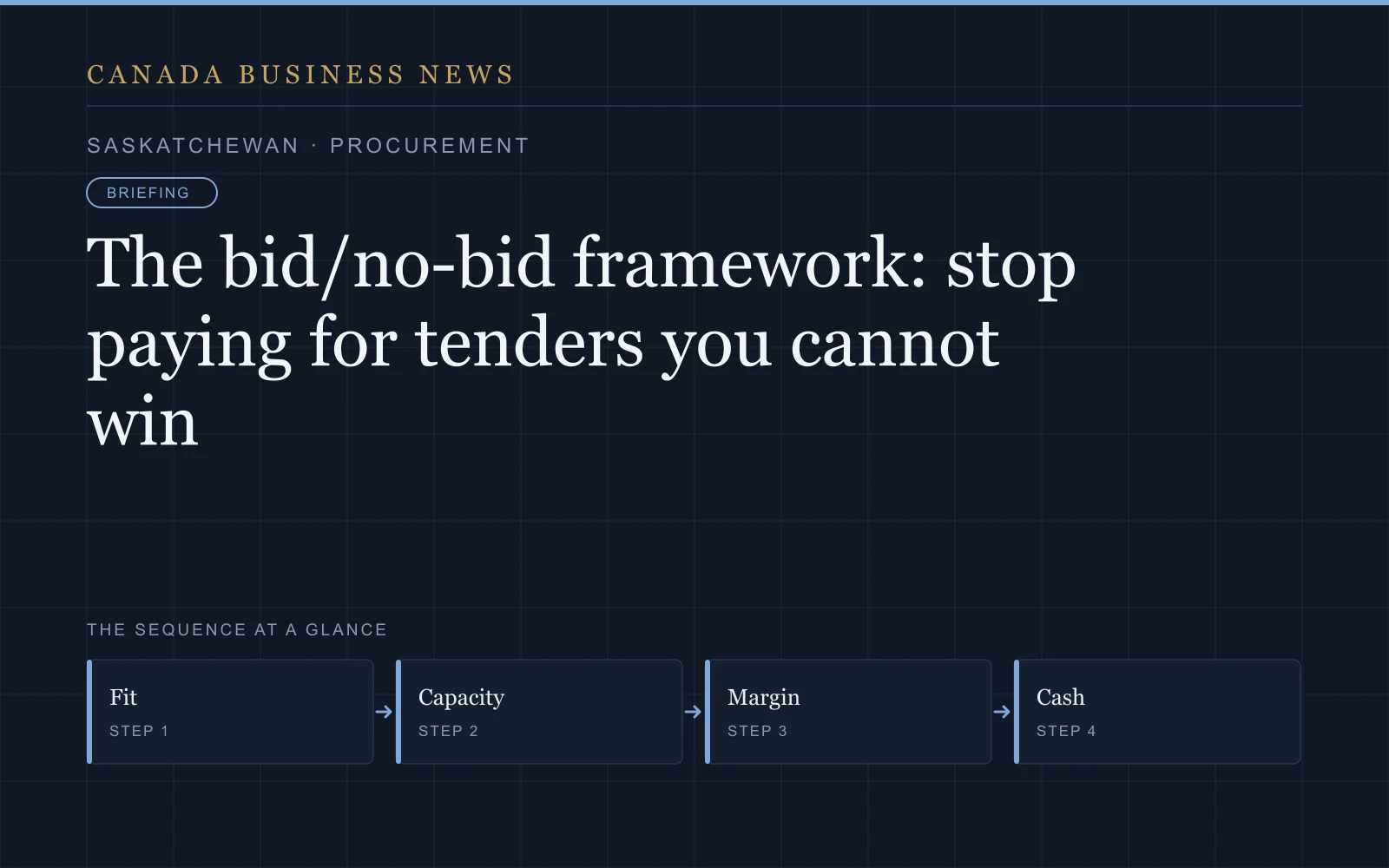
Bid/no-bid scoring grid
Four tests applied before estimating hours are spent.
Demonstrable work with references the buyer will respect.
Crews, equipment, and supervision available in the stated window.
Tender structure and buyer history allow a liveable price.
Payment terms, holdbacks, and mobilization fit the balance sheet.
Source basis: Constructed from CanadaBuys tender guidance
A tender response is a purchase. The firm buys a chance at the contract with estimating hours, subcontractor quotes, bonding room, and management attention. Firms that treat bidding as free respond to everything, win erratically, and never learn why.
A written bid/no-bid framework is the cheapest procurement tool a small firm can adopt, and it matters most in markets like Saskatchewan where crews and equipment are the constraint, not ambition.
The four questions before pricing
Fit: is this the work the firm demonstrably does, with references the buyer will respect? Capacity: can the crews, equipment, and supervision deliver in the stated window without starving current customers? Margin: does the buyer's history and the tender's structure allow a price the firm can live with? Cash: do the payment terms, holdbacks, and mobilization costs fit the firm's balance sheet?
Score each honestly from the tender documents and the firm's own numbers. Two weak answers out of four is a no-bid, and writing down the reason builds the dataset that sharpens the next decision.
Reading the tender for winnability signals
Tenders telegraph their openness. Short response windows, highly specific technical requirements, or evaluation criteria weighted to incumbency suggest a buyer with a preferred outcome. Clear scopes, reasonable timelines, and published evaluation grids suggest a genuinely open competition.
Saskatchewan firms can watch these signals across federal tenders on CanadaBuys and provincial and municipal opportunities through the province's business portals. The pattern-reading skill compounds: after twenty tenders in a lane, the winnable ones announce themselves.
Tracking the record
Keep a simple register: tender, buyer, bid or no-bid, reason, result, and final margin where won. Within a year the register answers the strategic question no consultant can: which buyer types, scopes, and sizes this specific firm converts.
That record also feeds funding conversations. Regional development programs assess growth plans more favourably when the firm can show a disciplined pipeline rather than a hopeful one.
Government links used for this briefing
These links point to federal, provincial, territorial, municipal, intergovernmental, or official data sources. Readers should confirm current eligibility and deadlines directly with the issuing government before applying.
Official guidance covering the tender process the framework scores against.
Provincial / ProgramBusiness and industryGovernment of SaskatchewanProvincial portal for Saskatchewan registrations, programs, and procurement-adjacent resources.
Federal / ProgramFunding for businesses in the Prairie provincesPrairies Economic Development CanadaFederal regional programs that assess growth plans a disciplined bid pipeline supports.