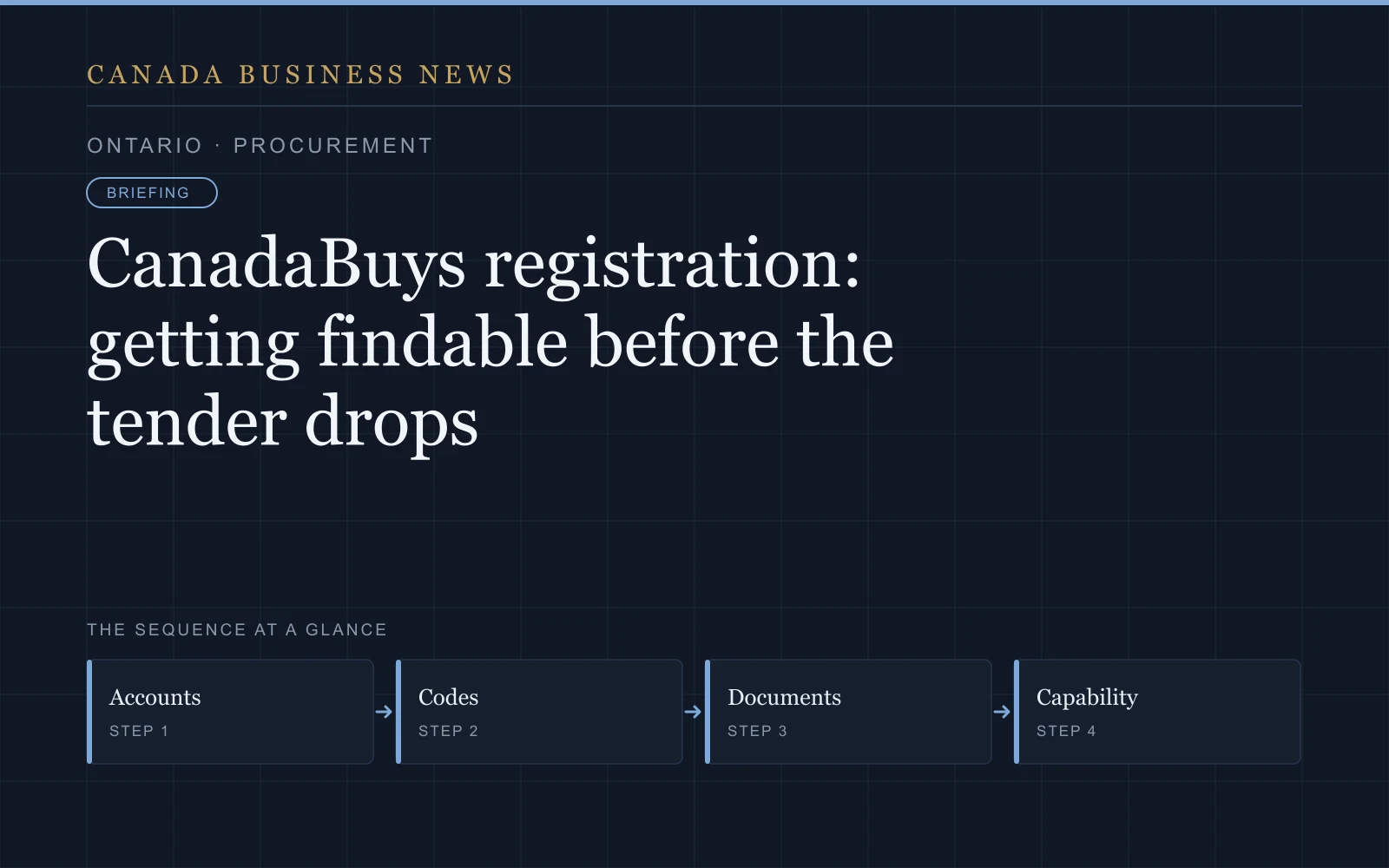
Registration-to-invitation path
The sequence from accounts to buyer visibility, done before a live tender creates pressure.
Create the tendering account and business identifiers; assign one owner for credentials.
Select commodity classifications that describe delivered work; review twice a year.
Maintain one folder of insurance, safety, references, and CRA standing.
Write the one-page statement in the buyer's vocabulary; subscribe to tender notifications.
Source basis: CanadaBuys getting-started guidance
Federal procurement runs through CanadaBuys, and the firms that win there share a boring secret: their registration, identifiers, and profile were finished long before the tender they wanted appeared. Registering during a live bid window means learning the plumbing while the clock runs.
The official guidance for new suppliers lays out the sequence, and none of it is difficult. What separates suppliers is how deliberately the profile is built once the accounts exist.
The plumbing: accounts and identifiers
The CanadaBuys getting-started guidance walks new suppliers through creating an account on the tendering platform and obtaining the business identifiers federal buying requires. Do this in a quiet week. Assign one person to own the credentials and record them somewhere the business, not an individual inbox, controls.
While registering, pull the firm's CRA standing and standard documents into one folder: insurance certificates, WSIB or provincial equivalents, safety records, and references. Federal bids ask for the same evidence repeatedly, and the firms that respond fast keep it current rather than fresh-building it per bid.
Commodity codes and the visibility problem
Buyers search by commodity classification, so the codes a supplier selects are effectively its shelf placement. Choose too few and the firm is invisible; choose codes that flatter rather than describe and the firm receives invitations it cannot serve. Map codes to the work the firm actually delivers and revisit them twice a year.
Set up tender notifications for those codes immediately. The rhythm of seeing real tenders, their scopes, their evaluation criteria, and their timelines, teaches more about federal buying than any seminar, even before the firm bids.
The capability statement that does the converting
A capability statement is one page: what the firm delivers, for whom, at what scale, with what certifications, and the proof. Write it in the buyer's vocabulary from real tender documents, not the firm's marketing language. Its job is to let a procurement officer justify inviting the firm in thirty seconds.
Smaller and newer suppliers should also watch the modernization measures aimed at small-business access, and consider subcontracting to incumbent primes as the fastest route to federal past-performance. The first federal reference changes every bid that follows.
Government links used for this briefing
These links point to federal, provincial, territorial, municipal, intergovernmental, or official data sources. Readers should confirm current eligibility and deadlines directly with the issuing government before applying.
Official federal guidance on registering, identifiers, and preparing to bid on government tenders.
Federal / ProcurementPSPC small business procurement program measuresPublic Services and Procurement CanadaOfficial announcement of measures to modernize federal contracting and boost small-business access.
Federal / ComplianceCRA My Business AccountCanada Revenue AgencyPortal for confirming the business's CRA standing that bids and registrations rely on.