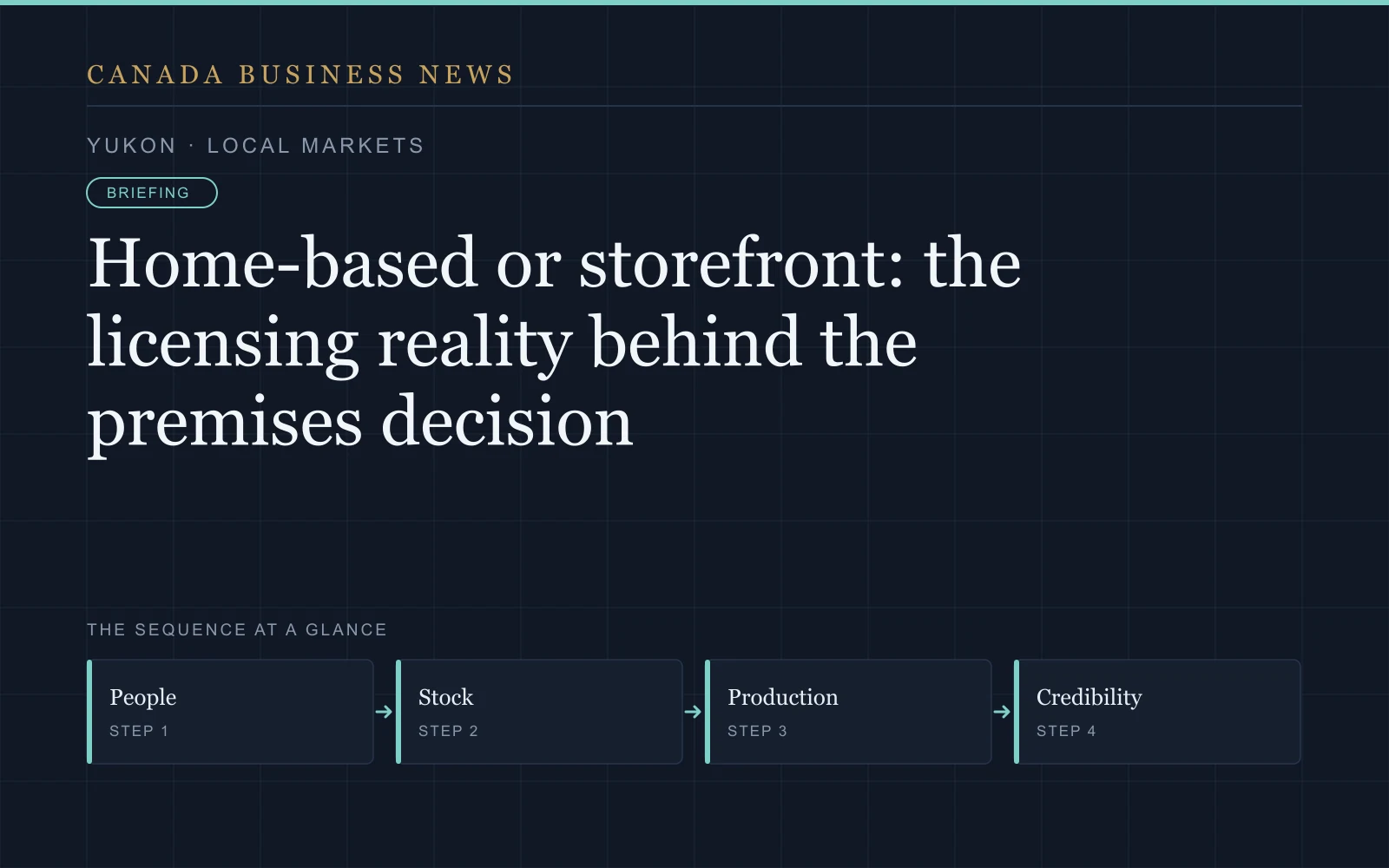
Premises decision triggers
The growth events that end home-based status, planned for rather than suffered.
Staff beyond permitted counts or client traffic the street notices.
Inventory and storage beyond residential limits.
Noise, venting, or activity residential zoning excludes.
The commercial-address need that signals the planned move.
Source basis: City of Whitehorse business licence framework
Most Canadian businesses start at a kitchen table, and municipalities have rules for exactly that. Home-based business is a licensed category with conditions on client visits, staffing, signage, storage, and nuisance, and the operator who never reads them is running on luck.
In Whitehorse, where the city licenses home-based operations under its business licence framework, the decision carries northern weight: housing is tight, commercial space is limited, and the premises choice is a cash-flow decision measured against both.
What home-based licensing typically allows
Municipal frameworks generally permit low-impact operation: the business as secondary use of the dwelling, limits on non-resident employees working on site, restrictions on client traffic and parking, constrained signage, and rules about outdoor storage and noise. Whitehorse's business licence pages carry the local version; every municipality's differs in detail and rhymes in substance.
Insurance is the parallel track owners skip: a home policy does not automatically cover business activity, inventory, or client injury on the premises. The licence and the insurance call should happen the same week.
The triggers that force the move
Growth breaks home-based status in predictable ways: staff beyond the permitted count, client volume the street notices, inventory beyond what a garage hides, production activity with noise or venting, or the simple credibility need of a commercial address. Recognizing the trigger early converts a forced, rushed move into a planned one.
The planned version uses the lease disciplines any tenant needs, fixturing period, realistic additional rent, permit timing, and in small northern markets it starts earlier because inventory is thin.
The northern calculation
Where housing and commercial space are both scarce, the premises decision interacts with hiring: a storefront that consumes the margin that would have funded a wage, in a market where workers already struggle to house themselves, can shrink the business while appearing to grow it. Territorial business supports can carry some expansion costs, and the honest twelve-month cash model, home-based versus leased, is the decision tool that keeps the move a step forward.
Government links used for this briefing
These links point to federal, provincial, territorial, municipal, intergovernmental, or official data sources. Readers should confirm current eligibility and deadlines directly with the issuing government before applying.
Municipal licensing framework covering home-based operation in Whitehorse.
Territorial / ProgramFunding for businessesGovernment of YukonTerritorial supports that can carry part of an expansion into commercial space.
Federal / PermitPermits, licences and regulationsGovernment of CanadaFederal gateway to the permit layers a premises change can trigger.