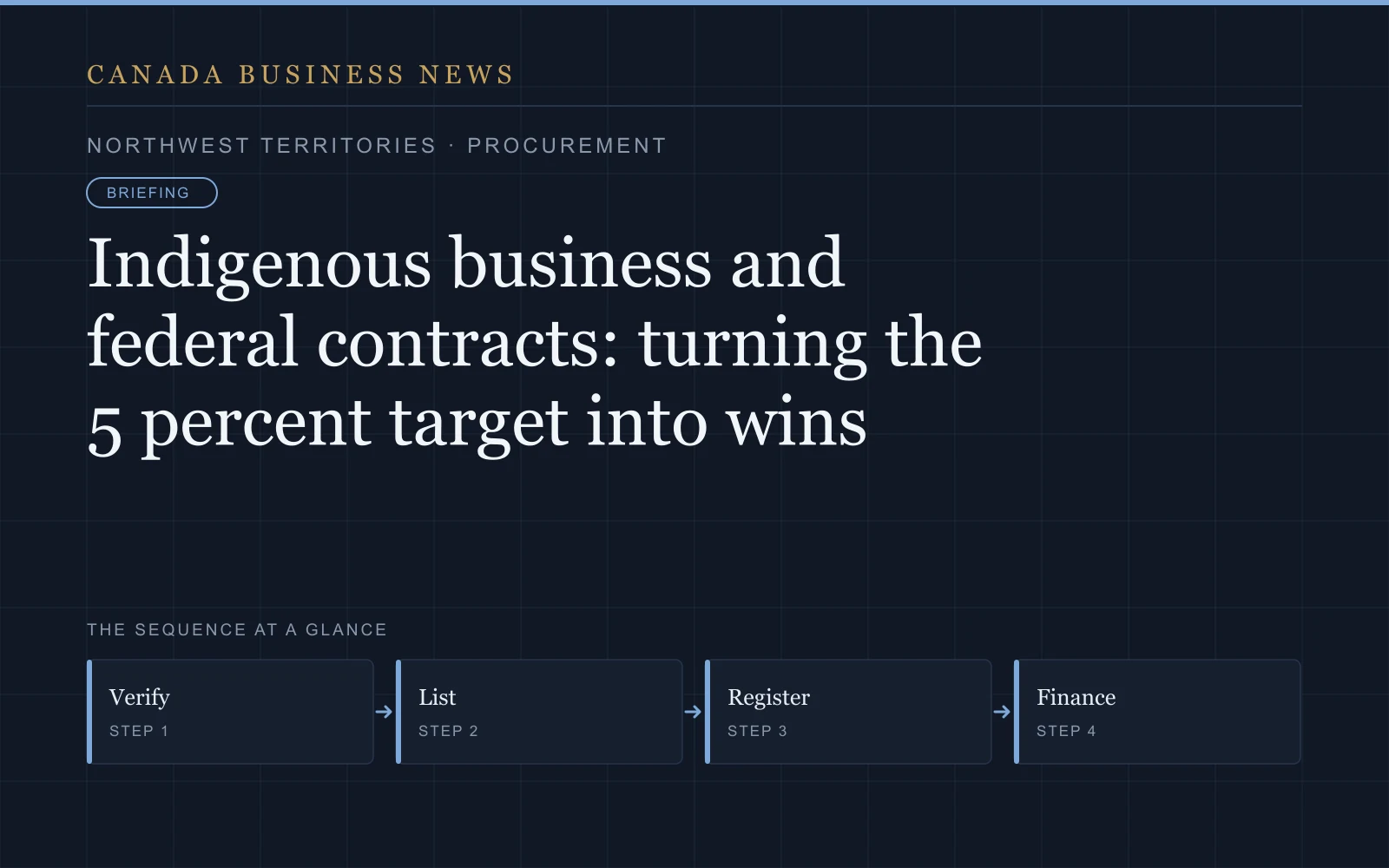
Set-aside access path
From ownership records to financed delivery under the 5 percent target.
Assemble incorporation and ownership records proving Indigenous ownership and control.
Register in the Indigenous Business Directory for set-aside visibility.
Complete standard CanadaBuys registration; set-asides run through the same machinery.
Line up NACCA-network or territorial financing when the bid is submitted.
Source basis: Indigenous Services Canada procurement pages
The Government of Canada requires that a minimum of 5 percent of the total value of federal contracts be held by Indigenous businesses. That target, described on Indigenous Services Canada's procurement pages alongside a transformative procurement strategy under development, is a structural demand signal for Indigenous-owned firms in every region, and its weight is felt strongly in the North.
The distance between the policy and a firm's first contract is process: registration, visibility, and bid readiness. Each step is documented, and none requires a consultant to start.
Registration and the directory
The Indigenous Business Directory is the visibility layer: federal buyers use it to identify firms for set-aside and targeted opportunities. Registration verifies Indigenous ownership and control, so incorporation documents and ownership records should be assembled first.
Once listed, the firm should complete the same CanadaBuys registration any federal supplier needs, because set-aside tenders still run through the standard tendering machinery, with the same identifiers, commodity codes, and notification tools.
Reading set-aside and northern opportunities
Set-aside opportunities restrict competition to registered Indigenous businesses, which changes bid math: smaller fields, but the same delivery obligations. Northern firms should also track territorial procurement policies and comprehensive land-claim obligations that shape how federal work in the territories is tendered.
The bid/no-bid discipline still applies. A set-aside win that outruns the firm's delivery capacity damages the record that future evaluations weigh. Capacity-matched contracts, delivered cleanly, compound.
Financing the contract after the win
Public contracts pay on delivery schedules, and mobilization costs arrive first. The NACCA network of Indigenous financial institutions exists for exactly this gap, alongside territorial supports and CanNor project funding where expansion is involved.
Owners should line up the working-capital conversation when the bid is submitted, not when the award letter lands. A financing partner who has seen the tender can move at contract speed.
Government links used for this briefing
These links point to federal, provincial, territorial, municipal, intergovernmental, or official data sources. Readers should confirm current eligibility and deadlines directly with the issuing government before applying.
Official source for the mandatory minimum 5% Indigenous procurement target and the Indigenous Business Directory.
Federal / ProcurementPreparing to sell to governmentCanadaBuysStandard federal supplier registration that set-aside tenders still run through.
Federal / ProgramNational Aboriginal Capital Corporations AssociationNACCA (Indigenous-led, federally supported network)Network of Indigenous financial institutions financing the working capital contracts demand.
Federal / ProgramCanNor Expression of Interest for funding projectsCanadian Northern Economic Development AgencyFederal project funding for northern capacity expansion behind larger contracts.