The first two pieces in this investigation established two hard facts. First, at least eleven energy infrastructure projects are moving through Alberta and BC regulators right now, each with a construction workforce that will shrink 10-to-1 or more once operations begin. Second, four decades of government data show the province's boom-bust cycle is real but uneven: some sectors and signals move together tightly, others barely move at all, and the businesses that get hurt worst are usually the ones that mistook a construction-phase spike for a new normal.
This piece turns both findings into a framework a small-business owner can actually use, whether the opportunity in front of them is a major LNG build, a pipeline expansion, or the next cycle after that.
Reframe the question
The wrong question is "will there be a boom." Alberta has had five of them since 1979, so the answer is almost certainly yes, eventually, somewhere. The right question is how to structure a business so the windfall adds to its strength permanently while its exposure to the following bust stays temporary and bounded.
That reframing changes concrete decisions: which costs to make fixed versus variable, how large a cash reserve to hold, which signals to actually watch, and how to treat a construction-phase customer relationship differently from an operations-phase one.
The windfall curve
A conceptual map of the three phases a small-business owner near a major project actually experiences, built from the patterns in this investigation rather than from any single project's published schedule.
Source: CBN analysis, built from the government figures cited throughout this series
Pre-construction: position without overcommitting
Once a project clears its regulator, and this investigation's companion piece shows exactly how to tell an actual approval from a recommendation or a proposal, there is typically a window of months to a few years before peak construction spending arrives. This is the cheapest time to position, and the easiest time to overcommit.
The practical moves: get on the project's local supplier or vendor list where one exists, confirm municipal licensing and any permits well ahead of demand rather than during it, and build relationships with the project's procurement or community-relations office. Avoid signing a longer lease, a larger loan, or a bigger staff commitment based on projected construction-phase volume before that volume has actually shown up in the business's own receipts. A signed contract with the project itself is a different kind of evidence than a general expectation that the area will get busier.
Peak construction: capture the windfall on a variable-cost structure
This is the phase most businesses plan for and most also mismanage, because the temptation is to treat a construction-phase surge as the business's new steady state. The data investigation in this series' second piece shows why that's dangerous: even in the sectors furthest from the energy sector itself, adjacent to but not part of it, revenue swings have historically been real but smaller in amplitude than the underlying price or workforce shock, meaning the surge itself is often less permanent than it feels while it's happening.
Favour costs that scale down as easily as they scaled up: seasonal or contract staff over permanent hires where the work genuinely is temporary, shorter equipment leases over long-term purchases, and month-to-month or short-term space arrangements over multi-year commitments, if that space is being taken specifically to serve construction-phase demand rather than the business's underlying, durable customer base.
Size the cash reserve to the fastest real shock, not the average one
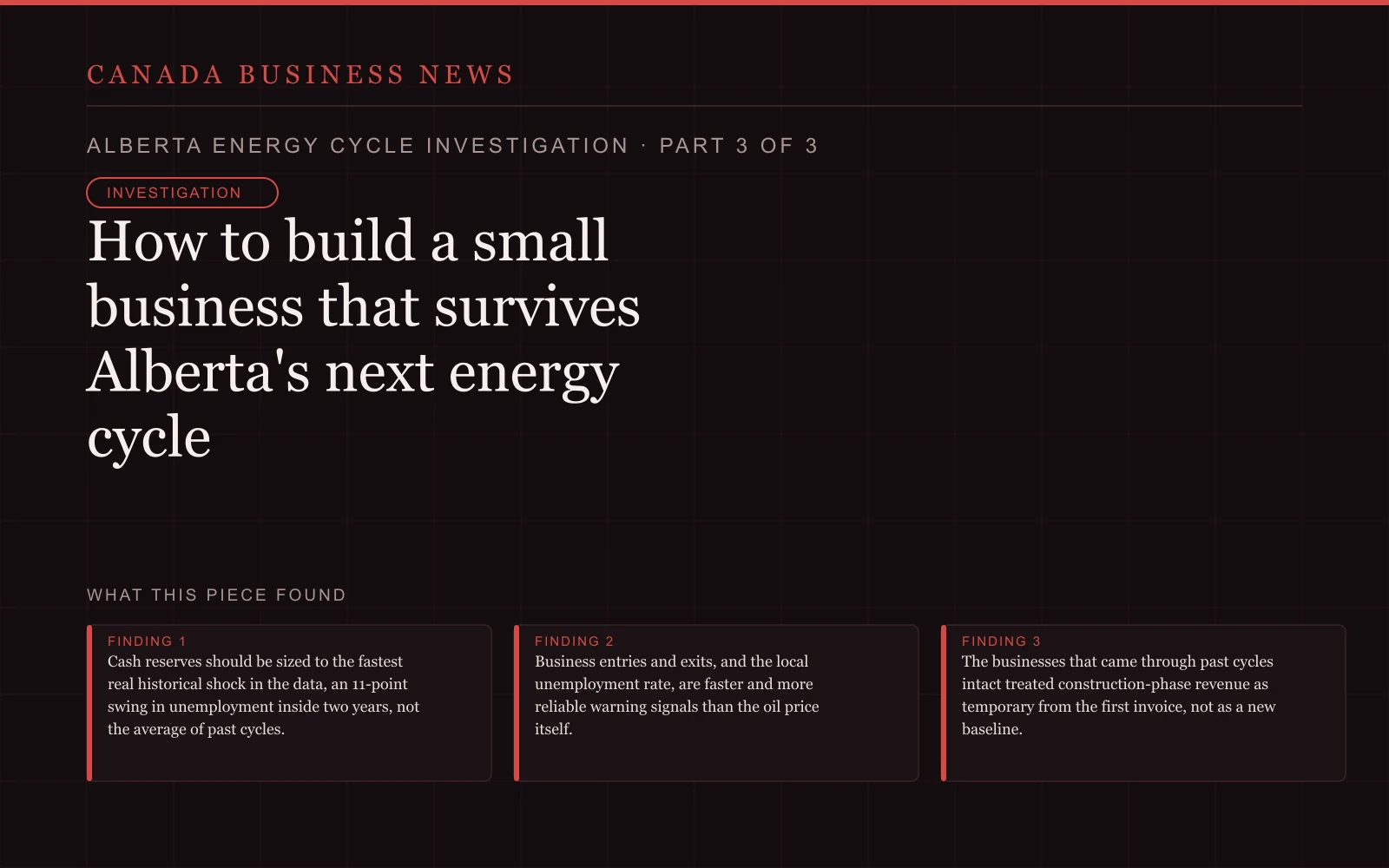
The investigation's data shows Alberta's unemployment rate has moved as fast as 4.5 percentage points in a single year (2019 to 2020) and as much as 6.5 points across three years during the 1980s NEP-era bust. A reserve sized to a mild, gradual downturn will not survive a shock of that speed.
A workable rule from this data: hold enough cash and available credit to cover fixed costs, rent, loan payments, core payroll, for at least six months at reduced, non-construction-phase revenue, and treat that reserve as untouchable during the good years specifically because the good years are when it's easiest to convince yourself it won't be needed. The Canada Small Business Financing Program and standard working-capital lines are tools for growth, not substitutes for a reserve; a facility that has to be renewed or approved during a downturn is not the same as cash already in the business.
Watch the fast signals, not just the price ticker
The correlation investigation in this series found that the oil price itself is a weaker, laggier predictor of broad small-business conditions than two other signals: the local unemployment rate, and whether business entries or exits are winning in the owner's own sector and region. Both are publicly available from Statistics Canada well before an owner's own receipts would show a slowdown.
A practical habit: check the regional unemployment trend and, where available, sector-level business entry and exit data on a quarterly cadence, not the oil price on a daily one. A rising local unemployment rate two quarters running is a more actionable warning than a single bad week in crude futures.
Diversify away from the single-buyer trap
The sharpest finding in the correlation investigation was sectoral, not aggregate: the oil and gas extraction sector's own insolvency filings rose roughly ninefold in the 2014-2016 window while construction, the sector most people assume absorbs the same shock, actually declined. That is a count, not a normalized failure rate, but the direction is unambiguous: the damage concentrated hard in businesses tied directly to the sector, not evenly across everything nearby. The lesson generalizes beyond that one cycle: a business that derives most of its revenue from one project, one buyer, or one workforce population is carrying a concentration risk the aggregate provincial data will not show up in until it's already a problem for that specific business.
Where the opportunity allows, build a second and third customer base during the construction-phase windfall, ideally ones with a different economic driver than the project itself, using the windfall's cash flow to fund that diversification rather than to expand capacity that only the project's construction phase can fill.
Operations phase: right-size deliberately, don't wait to be forced
The construction-to-operations cliff documented in this series' first piece, roughly a 10-to-1 workforce drop for LNG Canada, more than 70-to-1 by some measures for Coastal GasLink, is not a surprise event. It's a scheduled one, visible in the project's own government filings well before it happens.
The businesses that come through it intact are the ones that used the construction-phase windfall to build permanent strength, paid-down debt, upgraded equipment, a diversified customer base, rather than permanent capacity sized to the temporary population. Right-sizing staff, space, and inventory ahead of the transition, on the project's own published schedule, is a controlled decision. Doing it after revenue has already fallen is a forced one, and the data in this investigation shows which businesses in past cycles ended up making it the hard way.
Where to check the official numbers
None of the specific figures in this framework need to be taken on faith. The Canada Small Business Financing Program page details current asset-financing terms, the Business Benefits Finder surfaces federal and provincial supports relevant to a specific expansion or diversification plan, and Statistics Canada's Labour Force Survey and Business Dynamics tables, the same tables this investigation drew from, are public and updated regularly enough to serve as an ongoing monitoring source rather than a one-time read.
Government links used for this briefing
These links point to federal, provincial, territorial, municipal, intergovernmental, or official data sources. Readers should confirm current eligibility and deadlines directly with the issuing government before applying.
Official federal loan-guarantee program for eligible asset purchases and improvements.
Federal / ProgramBusiness Benefits FinderGovernment of Canada / Innovation CanadaOfficial gateway for matching a business to federal and provincial support programs.
Federal / EvidenceLabour force characteristics by province, territory and economic region, annualStatistics CanadaOngoing source for the unemployment-rate monitoring signal recommended in this piece.
Federal / EvidenceBusiness dynamics measures, by industry, per province or territoryStatistics CanadaOngoing source for the business entries/exits monitoring signal recommended in this piece.
Provincial / ProgramSmall business resourcesGovernment of AlbertaProvincial resource page for Alberta operators planning expansion or diversification.