Grant-safe project sequence
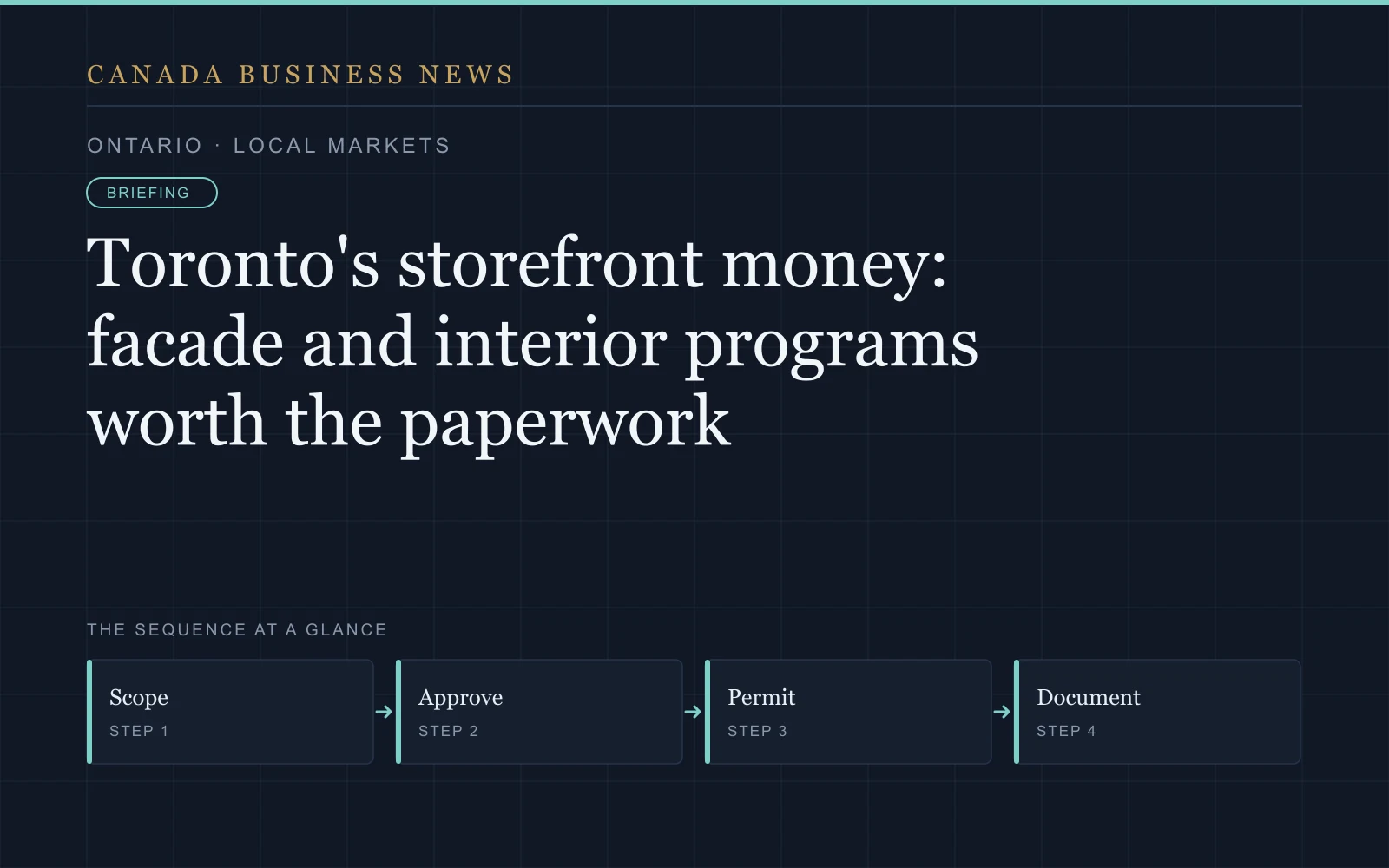
The ordering that keeps municipal money attached to the project.
Quotes and design for the improvement, mapped to program-eligible costs.
Program application approved before any work begins.
Building and sign permits run in parallel with the approval.
Invoices and before-and-after photos kept live for the claim.
Source basis: City of Toronto business incentive pages
Municipal improvement grants are the most overlooked money in main-street retail, because owners assume city programs are ceremonial. Toronto's are not: the city's business incentive pages carry active programs for commercial facade improvement and commercial space renovation, alongside startup-oriented grant streams.
The programs share a logic: the city part-funds visible improvements to commercial streets, and the operator gets a better storefront for a fraction of its cost. The catch is sequencing.
What the programs cover
The facade stream supports exterior improvements, storefronts, signage, lighting, accessibility, in eligible areas; the space renovation stream reaches interior commercial improvements; and the city's small-business funding pages list the current intake conditions, eligible areas, and cost-share terms for each. Eligibility geographies and percentages change, so the live city pages govern any plan.
The consistent condition across municipal improvement programs: apply and be approved before work begins. Work already started is the standard disqualifier, and it is the one owners hit most because contractors' schedules drive the timing.
Sequencing one clean project
Order the steps: scope the improvement with quotes, confirm program eligibility for the address, apply and receive approval, secure any building or sign permits the scope needs, then build. Owners who run permits and the grant application in parallel, before the contractor mobilizes, compress the calendar without breaking either process.
Keep the claim file as the project runs: approvals, invoices, before-and-after photos. Municipal reimbursements pay against documentation, and the file built live is the file that pays fast.
Beyond Toronto
The pattern generalizes. Calgary runs downtown conversion and industrial incentive programs; many municipalities operate facade streams through business improvement areas. Any operator planning storefront work anywhere should spend thirty minutes on their city's business pages before the contractor is booked, because the programs only pay the prepared.
Government links used for this briefing
These links point to federal, provincial, territorial, municipal, intergovernmental, or official data sources. Readers should confirm current eligibility and deadlines directly with the issuing government before applying.
Official municipal program page for facade improvement funding.
Municipal / ProgramCommercial space renovation grant programCity of TorontoOfficial municipal program page for interior commercial renovation funding.
Municipal / ProgramFunding for small businessesCity of TorontoThe city's index of current small-business funding streams and conditions.
Municipal / ProgramIndustrial incentiveCity of CalgaryExample of the same municipal-incentive pattern in another major city.