Toronto Small Business Funding, Grants, Permits and Tax Credit Guide 2026
Government-source Toronto funding guide covering city grants, export micro-grants, tax credits, procurement, permits, and readiness steps.
This guide uses official government or government-adjacent sources. Dollar figures, percentages, deadlines, statutes and program statuses are cited directly below. Readers should always confirm the live program page before applying.
Toronto operators need a funding stack, not a list of links. The practical order is permit risk first, municipal incentives second, federal tax credits third, export support fourth, and procurement readiness throughout. A restaurant renovating a commercial unit, a clinic buying equipment, a manufacturer adapting a process, and an export-ready service firm all have different pathways, but the same rule applies: do not spend first and search for money later.
This guide uses only official government and government-adjacent sources. It distinguishes open intakes from closed-watch programs, automatic rebates from applications, grants from tax credits, and procurement from funding. The purpose is to let a Toronto owner decide what to prepare this week: which portal to open, what documents to gather, which deadlines matter, and which programs belong in the financial model before a lease, buildout, export push, or R&D project begins.
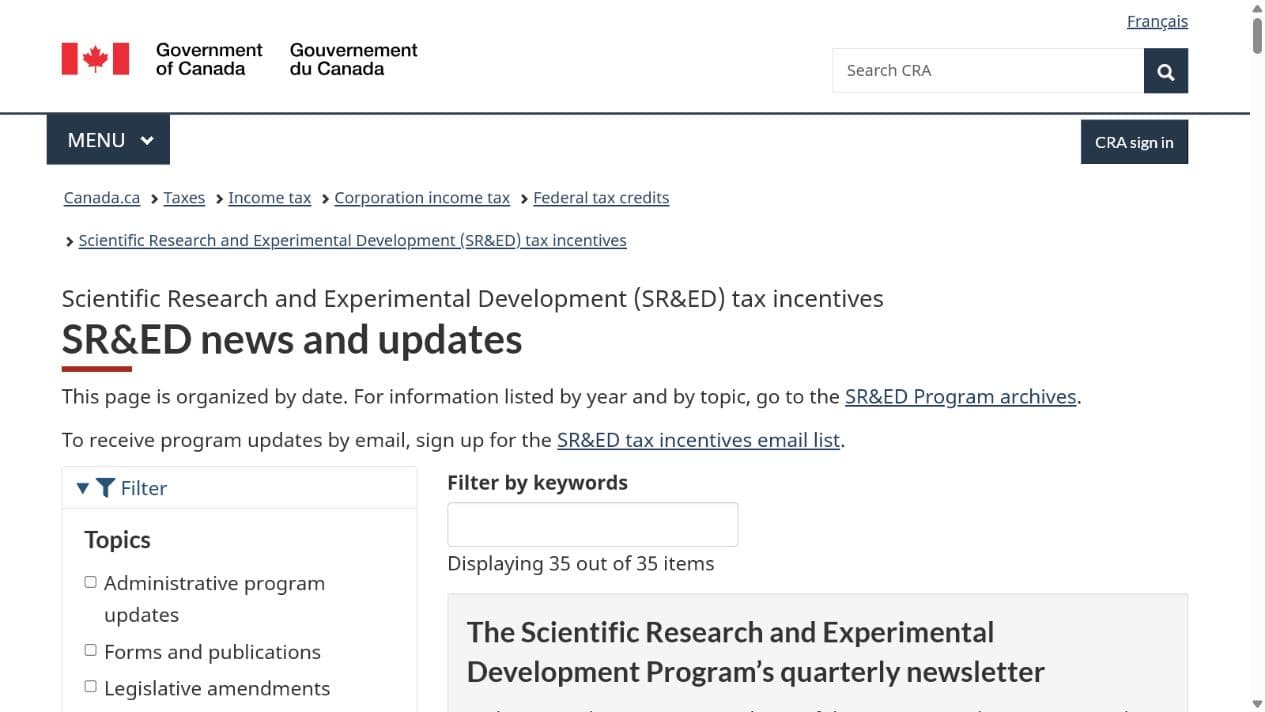
SR&ED enhancements tied to Budget 2025 and Bill C-15
CRA's 2026 SR&ED updates reference Bill C-15 changes. Budget 2025 states the enhanced 35% credit expenditure limit is proposed to rise to $6 million for taxation years beginning on or after December 16, 2024, with phase-out boundaries moving to $15 million and $75 million.
Source: CRA SR&ED updates and Budget 2025Canada Carbon Rebate became non-taxable for all fuel charge years
CRA states that legislation passed March 26, 2026 made the Canada Carbon Rebate for Small Businesses non-taxable for all fuel charge years. Eligible CCPCs do not apply; CRA says payments are automatic.
Source: Canada Revenue AgencyFederal small-business procurement measures launched July 2026
PSPC announced targeted simplification measures under the Small Business Procurement Program and linked Innovative Solutions Canada to a $79.9 million five-year pathway for technology validation and procurement access.
Source: Public Services and Procurement CanadaToronto grant and incentive amounts verified from official pages
Closed programs stay in the chart because they remain high-value watchlist items. Do not treat a closed-watch program as currently open.
Toronto tax and federal opportunity levers
Percent charts show program mechanics, not approval odds.
Toronto funding file to prepare before applying
- Master Business Licence or articles of incorporation, active CRA business number, and commercial business bank account.
- Proof of Toronto commercial address, such as lease, property tax bill, utility bill, or ownership document.
- Current licence or certification for regulated operations, including food premises, personal services, clinics, child care, or trades where applicable.
- Budget with quotes, contractor estimates, design fees, eligible/ineligible cost split, HST treatment, and proof of applicant contribution.
- Year-to-date financial statements, previous year financials, CRA filings, payroll records, and explanation of any tax arrears.
- Before-and-after photos for facade or renovation projects, permission from the property owner when a tenant applies, and proof no work has started before approval where the program requires pre-approval.
Toronto permit readiness
- Confirm zoning and use before signing a lease.
- Identify whether building permits, change-of-use approvals, health inspections, sign permits, patio permissions, or business licences are required.
- Build the grant timeline around permit dependencies; some incentive pages disqualify work completed before approval.
- Keep drawings, landlord authorizations, contractor quotes, accessibility upgrades, and inspection records in the same project folder.
Step-by-step Toronto funding order
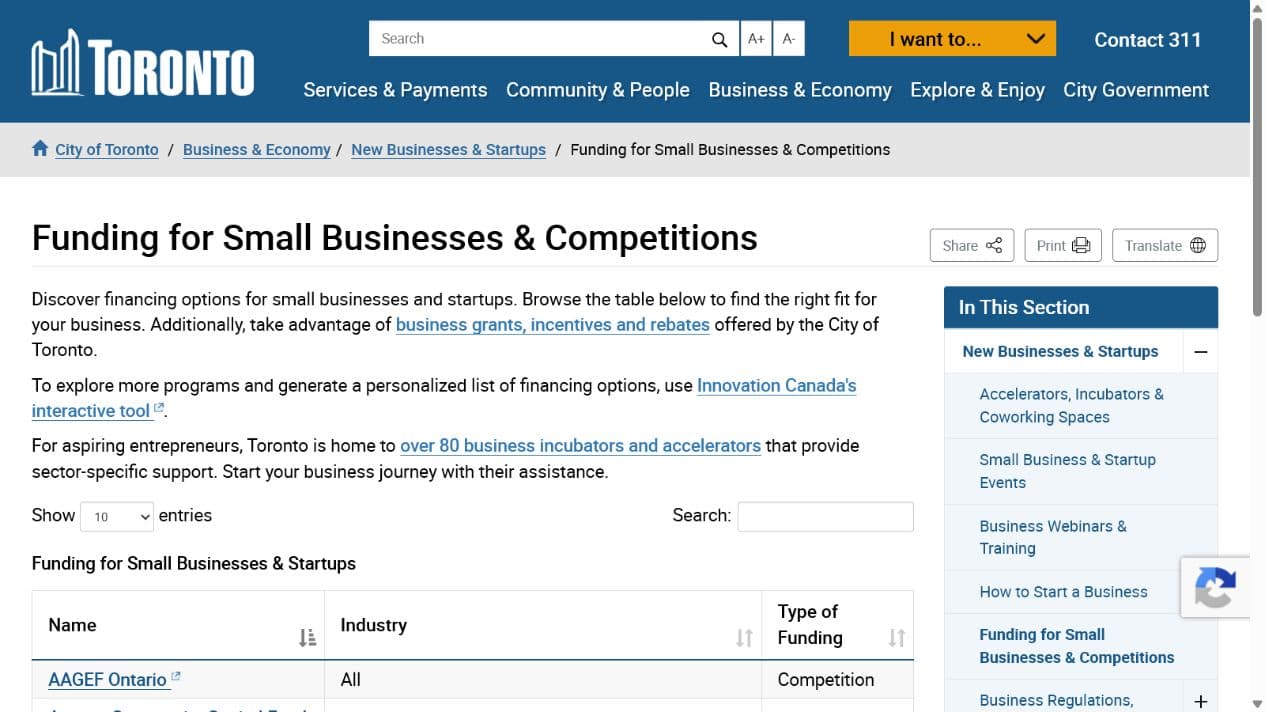
- Start with the City of Toronto funding portal and identify whether the project is startup, facade, interior renovation, export, industrial development, or tax-increment driven.
- Check the status line on each program page. If the program is closed, move it to a watchlist and subscribe to the City newsletter instead of modelling it as guaranteed money.
- Confirm the business is eligible before gathering documents: location, operating history, revenue threshold, year-round revenue, licence status, ownership, property-owner permission, and prior grant history.
- Build a budget that separates eligible improvements from ineligible maintenance, equipment, IT, stock purchases, furniture, or work already underway.
- For export projects, compare Toronto TAP with federal CanExport. TAP has a smaller micro-grant; CanExport has a larger competitive project structure and stricter SME criteria.
- For R&D, open the CRA SR&ED pre-claim process before work starts if the project is uncertain and technical enough to justify review.
- For procurement, build a CanadaBuys file and capability statement while the funding applications are in progress.
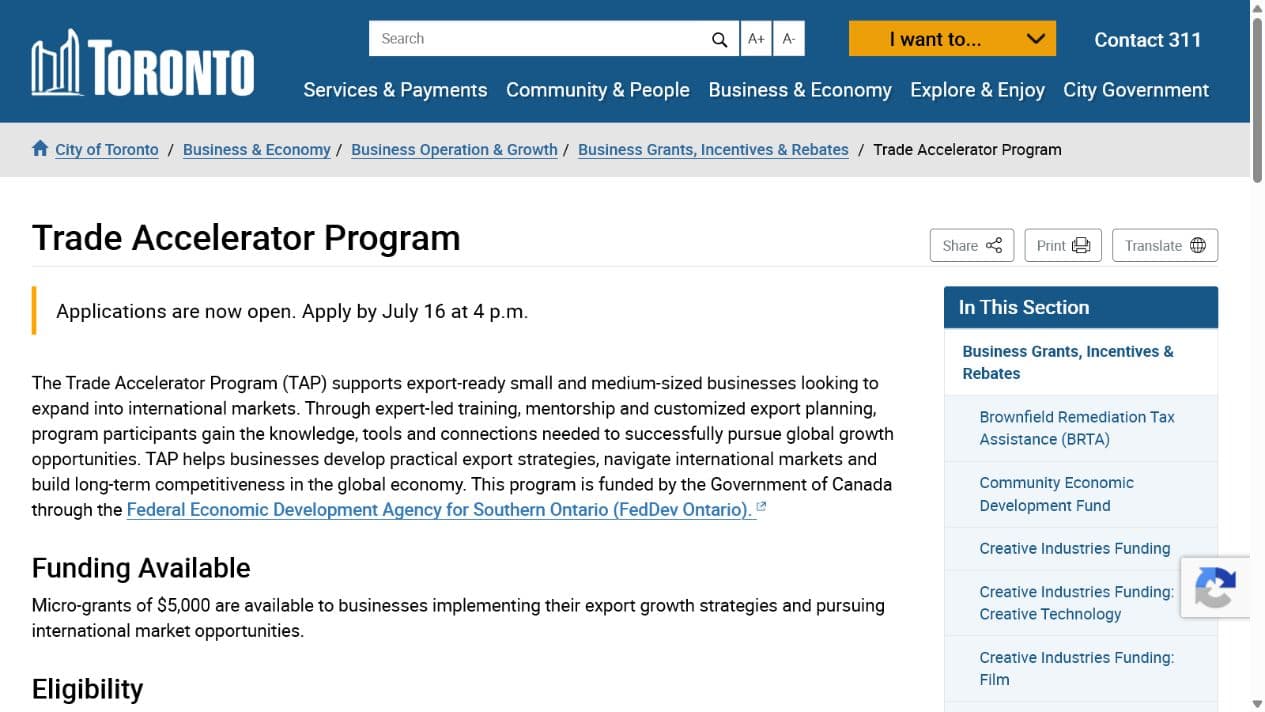
Trade Accelerator Program micro-grant
$5,000 micro-grant; City page says apply by July 16 at 4 p.m. when checked July 15, 2026.Export-ready Toronto SMEs implementing international growth strategies.
Eligibility signals
- Applicant must be 18 or older and a Canadian citizen or permanent resident.
- Business must be incorporated, have an active CRA business number, have a commercial bank account, have generated more than $50,000 in annual revenue, and have invested at least 25% of the grant amount.
- Business must operate year-round and not be a prior recipient of listed overlapping programs.
Documents to prepare
- Proof of business registration or articles.
- CRA business number.
- Commercial bank account proof.
- Financial activity statements.
- Proof of business address.
- Export growth strategy and eligible expense plan.
How to proceed
- Open the official City TAP page and confirm the intake is still open.
- Register for an information session if one is listed.
- Prepare documents before the deadline, especially revenue proof, address proof, and the 25% applicant investment evidence.
- Use the Apply Now button on the City page.
- Keep a copy of the submitted application and all source documents.
The deadline is extremely date-sensitive. Confirm directly on the City page before submitting.
Official source: City of TorontoCommercial Facade Improvement Grant Program
50% of eligible costs up to $12,500, with additional AODA and multi-unit funding described by the City.Storefront owners and tenants planning exterior improvements, signage, lighting, entrances, and accessibility upgrades.
Eligibility signals
- Applicant must be a property owner or commercial tenant with property-owner permission.
- A minimum of three eligible improvements is required.
- Work completed or underway before City approval can disqualify the application.
Documents to prepare
- Property-owner consent if tenant applies.
- Photos of existing facade.
- Quotes, design details, eligible improvement list, and accessibility details.
- Proof the property has not already received the maximum grant within the previous ten years.
How to proceed
- Treat the program as a watchlist item until the City opens applications.
- Do not begin work before approval if the next intake uses the same rules.
- Prepare three or more eligible improvements and separate AODA upgrades in the budget.
- Subscribe to the BusinessTO newsletter for intake updates.
Closed on the official page when checked. It is valuable, but not currently an apply-now program.
Official source: City of TorontoCommercial Space Renovation Grant Program
50% matching funding; up to $20,000 base, up to $4,000 AODA, and up to $20,000 multi-unit funding.Vacant storefront activation, interior improvements, AODA upgrades, and commercial space re-use.
Eligibility signals
- Owners and tenants of vacant properties; occupied properties may qualify under specific criteria.
- Street-level commercial properties or direct street access are emphasized.
- Minimum of three eligible improvements.
Documents to prepare
- Written permission from property owner for tenant applicants.
- Interior improvement budget, design fees, architectural or engineering quotes where applicable.
- AODA upgrade scope and cost separation.
- Proof of eligible property and project readiness.
How to proceed
- Keep the project ready but do not start before approval if the next intake uses the same rule.
- Build a matching budget showing the applicant's 50% contribution.
- Split base improvements, AODA upgrades, and multi-unit scope into separate budget lines.
- Subscribe to City updates and apply only through the official program page when reopened.
Closed on the City page when checked. Do not describe it to readers as open money.
Official source: City of TorontoStarter Company Plus Grant
$5,000 micro-grant plus training and advisory supports.Early-stage Toronto entrepreneurs with registered, operating small businesses.
Eligibility signals
- Canadian citizen or permanent resident, 18 or older.
- Registered business with Toronto address, commercial bank account, and minimum six months in operation.
- Must have already invested 25% of the grant amount, listed by the City as $1,250.
Documents to prepare
- Business registration documentation.
- Commercial bank account proof.
- Proof of Toronto business address.
- Proof of 25% applicant investment.
- Training availability and growth plan.
How to proceed
- Treat as a watchlist item because applications were closed on the official page when checked.
- Use the closed period to prepare business registration, address proof, bank account, and investment documentation.
- Subscribe to BusinessTO and apply only through the City page when a future round opens.
Do not spend assuming reimbursement. Wait for the City's next official intake rules.
Official source: City of TorontoEDGE Incentive Program
Temporary enhancement: 100% municipal tax increment grant for five years; minimum $3 million construction investment.Capital-intensive employment uses including manufacturing, biomedical operations, food and beverage wholesaling, incubators, film studio complexes, creative industries, and scientific research and development.
Eligibility signals
- Eligible development must be for an eligible sector/use.
- Minimum $3 million in building construction costs for eligible uses.
- Minimum 500 square metres added GFA, or 1,000 square metres rehabilitated space for substantial industrial renovation.
- Apply before first above-grade building permit is issued.
Documents to prepare
- Property-owner authorization.
- Construction budget and eligible-use area calculation.
- Planning, site plan, building-permit, and Toronto Green Standard materials.
- Sector/use evidence and development schedule.
How to proceed
- Confirm the development use appears in the eligible-sector list.
- Confirm the project meets construction-cost and gross-floor-area thresholds.
- Apply before the first above-grade building permit.
- Keep the tax-increment model separate from grants and financing; it is a property-tax incentive, not upfront cash.
This is a high-value but specialized incentive. It is not a main-street micro-grant.
Official source: City of TorontoSR&ED pre-claim approval process
Technical approval before work starts; approval can be valid for up to three years.Technology, manufacturing, food processing, clean-tech, life sciences, construction-tech, and process-improvement firms planning uncertain R&D work.
Eligibility signals
- Canadian-controlled private corporations, Canadian corporations, or Canadian partnerships.
- Annual gross income under $25 million.
- Business must be in good standing with the CRA.
Documents to prepare
- CRA My Business Account access.
- Project description, uncertainty, hypotheses, planned experiments, timelines, and technical staff roles.
- Existing internal documents, budgets, payroll assumptions, and contractor assumptions.
How to proceed
- Open a pre-claim approval request using the CRA web form; CRA says the form takes less than five minutes.
- Watch for a case number, which CRA says is normally issued in two to five business days.
- Complete the pre-claim approval application in My Business Account; CRA says up to three projects can be submitted.
- Meet with a CRA SR&ED specialist when contacted; new SR&ED claimants should expect a mandatory meeting.
- Wait for the official determination; CRA states the determination is issued within eight weeks of completing the application.
- If approved, keep the determination with payroll, contractor, material, prototype, testing, and project records before filing the SR&ED claim.
Pre-claim approval is technical approval, not permission to invent expenses later. Keep contemporaneous project and cost records.
Official source: Canada Revenue AgencyCanExport SMEs 2026-2027
$10,000 to $50,000 in requested funding; up to 50% of eligible project costs.Export-ready incorporated SMEs expanding into new international markets through travel, market intelligence, trade events, marketing, adaptation, or advisor work.
Eligibility signals
- For-profit incorporated legal entity, limited liability partnership, or cooperative established in Canada.
- Active CRA business number.
- Between 3 and 500 full-time employees.
- Between $300,000 and $100 million in annual revenue declared in Canada in the last complete tax reporting year, or last 12 months for monthly or quarterly filers.
Documents to prepare
- CRA business number and incorporation details.
- Project budget between $20,000 and $100,000.
- Target market selection, export plan, quotes, invoices or cost estimates, and proof of applicant cash contribution.
How to proceed
- Confirm the target country is new for the business under the CanExport rules.
- Build a project budget that requests $10,000 to $50,000 and leaves the applicant funding the other 50%.
- Map each cost to an eligible activity in the applicant guide before submitting.
- Submit during the published 2026-2027 application window, which the guide lists as February 4, 2026 to August 31, 2026.
- Do not start or incur costs before confirming program rules for your project; grant programs commonly reject pre-approval costs unless the guide permits them.
Funding is competitive and limited. Meeting eligibility does not guarantee approval.
Official source: Trade Commissioner ServiceCanada Carbon Rebate for Small Businesses
Automatic refundable tax credit for eligible CCPCs; final fuel charge year is 2024-2025.Eligible Canadian-controlled private corporations in designated provinces that filed corporation tax returns for the relevant fuel charge years.
Eligibility signals
- Canadian-controlled private corporation.
- Eligibility depends on the CRA rules for fuel charge years from 2019-2020 to 2024-2025.
- The CRA page says no application is required; eligible businesses automatically receive payment.
Documents to prepare
- Filed T2 corporation income tax returns.
- Payroll and employee counts by designated province, where applicable.
- CRA My Business Account access and direct deposit details.
How to proceed
- Confirm the business is a CCPC and has filed the relevant T2 returns.
- Confirm whether the business had employees in a designated province for the relevant years.
- Do not submit a separate application; CRA states eligible businesses receive the payment automatically.
- Review the CRA tax-treatment section because legislation passed March 26, 2026 made the rebate non-taxable for all fuel charge years.
British Columbia businesses generally should not assume eligibility unless they meet CRA's designated-province rules through payroll or operations covered by the program.
Official source: Canada Revenue AgencySmall Business Procurement Program and Buy Canadian measures
$79.9 million over five years for Innovative Solutions Canada support cited in the PSPC July 2026 release.Established B2B firms, manufacturers, technology companies, industrial service firms, logistics providers, and professional services firms pursuing federal contracts.
Eligibility signals
- Canadian small business with a product or service that can meet a federal purchasing need.
- Supplier must be prepared to use official procurement channels and meet contract requirements.
Documents to prepare
- CanadaBuys supplier profile and procurement categories.
- Capability statement, insurance, safety records, references, financial capacity, and pricing template.
- Security, accessibility, cyber, or certification records where required by the solicitation.
How to proceed
- Register and monitor official procurement channels, starting with CanadaBuys.
- Create a one-page capability statement tied to a real federal buying category.
- Build a reusable bid file before an opportunity appears.
- Track Innovative Solutions Canada where a department needs to develop, test, or validate new technology.
Procurement is not a grant. Treat it as a sales pipeline with compliance, capacity, and delivery risk.
Official source: Public Services and Procurement CanadaHow to avoid wasting a Toronto application
The most common failure pattern is applying too late in the project. A storefront owner signs a lease, starts demolition, orders materials, and then discovers that the grant rules require approval before work begins. A clinic buys equipment before financing is structured. A manufacturer begins technical work before SR&ED records exist. A service firm books export travel before CanExport confirms eligible timing. Toronto owners should create the funding file before the purchase order, not after.
The second failure pattern is confusing types of support. A grant lowers cash cost if approved. A tax credit may reduce tax or generate a refund after filing. A loan improves access to capital but still has repayment risk. A procurement program is a revenue channel, not funding. Each belongs in a different part of the financial model.
Best path for capital-intensive Toronto operators
Manufacturers, food processors, life-science firms, studios, and R&D-heavy companies should start with EDGE eligibility and SR&ED readiness before looking at smaller grant programs. EDGE can matter for property-tax economics on major construction or rehabilitation. SR&ED can matter for experimental development, prototypes, process improvement, software, materials testing, and technical uncertainty. The city grant pages are useful, but the largest opportunities often sit at the intersection of land, tax, R&D, and procurement.
For export-ready businesses, Toronto TAP and CanExport should be compared before the application is written. TAP is a smaller city-administered micro-grant with a tight local intake. CanExport is larger, federal, competitive, and built around a specific international-market project. The same business may not want to apply for both at the same time if staff capacity is limited; choose the program that matches the project value, timing, and target market.