Vancouver Small Business Funding, Licence, Training Grant and Export Guide 2026
Government-source Vancouver funding guide covering licences, B.C. training grants, PacifiCan, CanExport, SR&ED, and federal procurement.
This guide uses official government or government-adjacent sources. Dollar figures, percentages, deadlines, statutes and program statuses are cited directly below. Readers should always confirm the live program page before applying.
Vancouver businesses need a different funding map than Toronto or Calgary. The city-level starting point is licensing, land use, and operating permission; the higher-value money is more often provincial or federal: the B.C. Employer Training Grant, B.C.'s funding search portal, PacifiCan, CanExport, SR&ED, and procurement programs. A Vancouver owner should treat the City portal as the licence and local compliance gateway, then build the funding stack from B.C. and federal sources.
The important caution is the Canada Carbon Rebate. The CRA rebate is tied to designated-province fuel charge rules. British Columbia is not a normal assume-yes province for this rebate. Vancouver companies should not include carbon rebate cash in the forecast unless their own facts fit CRA's eligible CCPC and designated-province rules.
Free Trade and Labour Mobility in Canada Act in force January 1, 2026
The Government of Canada says Bill C-5 received Royal Assent June 26, 2025 and the Act and Regulations came into force January 1, 2026. Vancouver firms expanding interprovincially still must follow provincial and territorial rules.
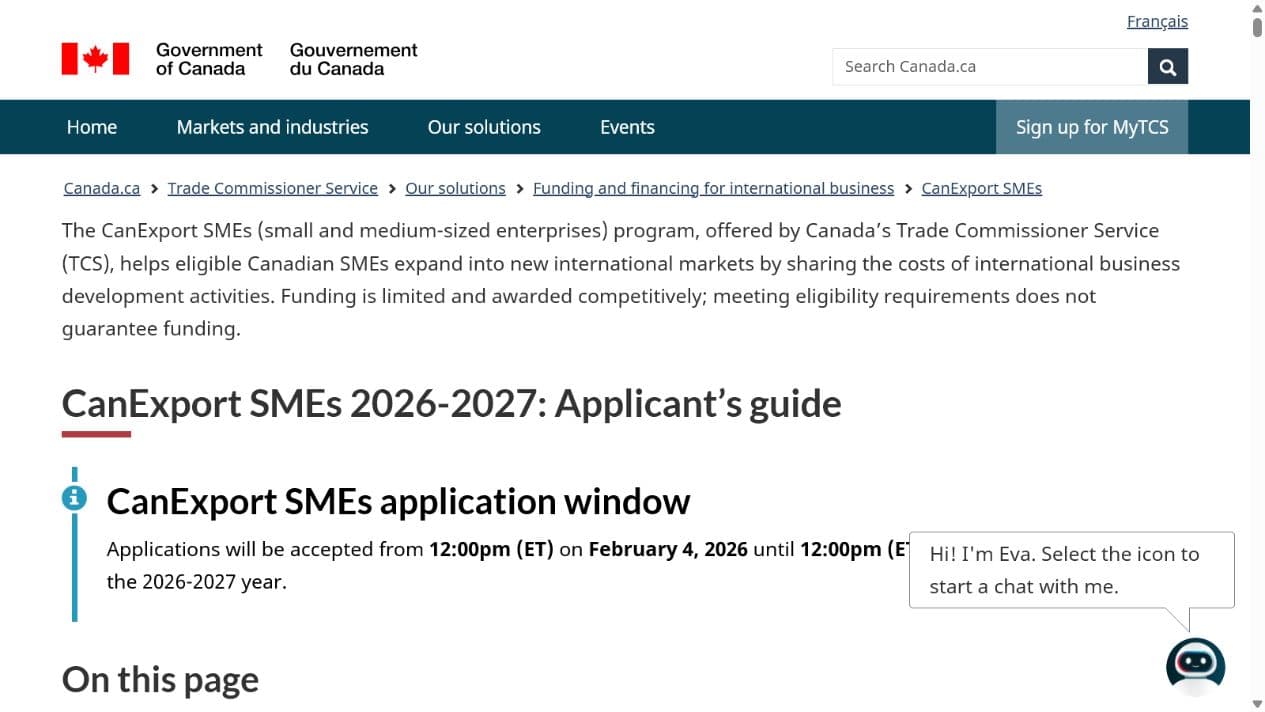
Source: Government of CanadaCanExport 2026-2027 application window
The official applicant guide says applications are accepted from February 4, 2026 to August 31, 2026 for the 2026-2027 year, with $10,000-$50,000 requests and up to 50% eligible-cost support.
Source: Trade Commissioner ServiceSR&ED pre-claim approval is live for eligible SMEs
CRA launched SR&ED pre-claim approval April 1, 2026 for eligible businesses under $25 million annual gross income.
Source: Canada Revenue AgencyB.C. and federal funding levers relevant to Vancouver SMEs
Dollar values are official caps or request ranges. Approval is not guaranteed.
Cost-share mechanics Vancouver owners should model
Percent values come directly from official program descriptions.
Vancouver licence and grant readiness file
- Business licence status, business address, ownership details, and any required land-use or permit confirmations from the City of Vancouver.
- Training plan with provider quotes, learning outcomes, participants, job roles, and timing before using the B.C. Employer Training Grant path.
- Export plan with target market, project budget, eligible costs, internal 50% contribution, CRA business number, incorporation details, employee count, and revenue proof for CanExport.
- SR&ED technical file: uncertainty, hypotheses, experiments, prototypes, staff time, contractor time, materials, and decision logs.
- Procurement file: capability statement, insurance, references, certifications, safety record, pricing model, and CanadaBuys registration.
Step-by-step Vancouver funding order
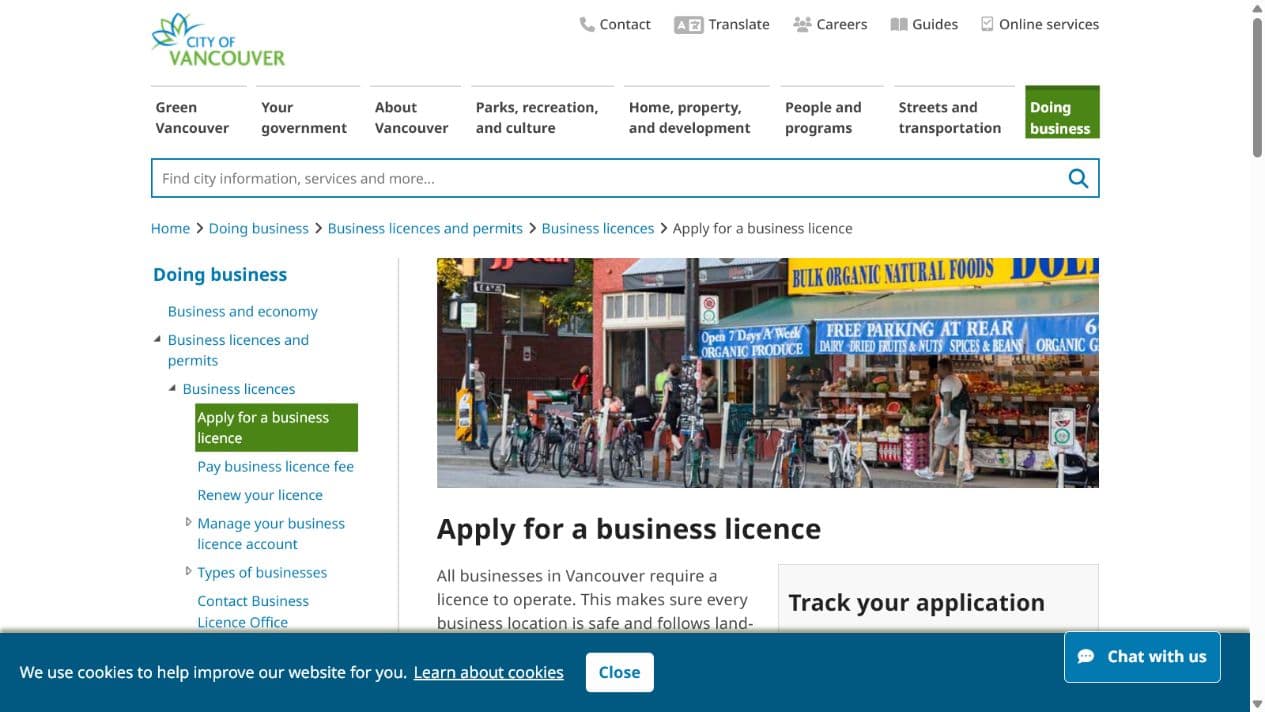
- Start with the City of Vancouver business licence page and confirm whether the operation, location, and use require a licence, permit, inspection, or land-use review.
- If the project is staff training, open the B.C. Employer Training Grant page and confirm current fiscal-year availability before paying the provider.
- If the project is international expansion, open the CanExport applicant guide and confirm the target market, request size, project value, revenue, employee count, and incorporation criteria.
- If the project is technical development, use CRA's SR&ED pre-claim approval before work starts or costs are incurred.
- If the business sells B2B to government, build a procurement file and monitor CanadaBuys and Innovative Solutions Canada rather than waiting for a perfect grant.
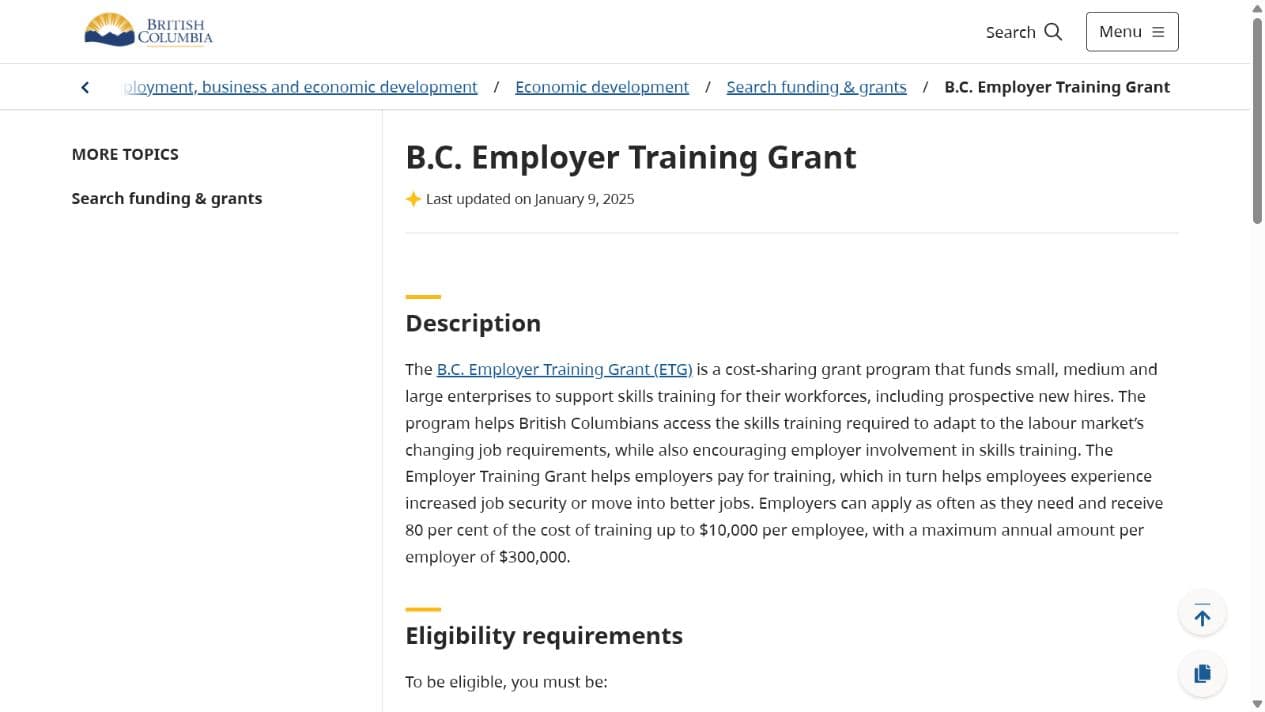
B.C. Employer Training Grant
80% of training cost up to $10,000 per employee; maximum annual amount per employer $300,000.Employers upgrading current workers or prospective new hires where training clearly improves job security, productivity, or skill fit.
Eligibility signals
- Employer or self-employed individual operating in B.C.
- Fully operational for at least one year at the time of application.
- In good standing with the Province.
Documents to prepare
- Training provider quote and course outline.
- Participant list, job roles, business rationale, and training dates.
- Proof of employer operation in B.C. and good standing.
How to proceed
- Confirm current intake status on the official B.C. page and WorkBC application pages.
- Select training that matches a documented business need.
- Gather provider quotes before applying.
- Wait for approval before assuming reimbursement.
The official page includes fiscal-year allocation language. Always confirm the current application period before committing training spend.
Official source: Government of British ColumbiaCanExport SMEs 2026-2027
$10,000 to $50,000 in requested funding; up to 50% of eligible project costs.Export-ready incorporated SMEs expanding into new international markets through travel, market intelligence, trade events, marketing, adaptation, or advisor work.
Eligibility signals
- For-profit incorporated legal entity, limited liability partnership, or cooperative established in Canada.
- Active CRA business number.
- Between 3 and 500 full-time employees.
- Between $300,000 and $100 million in annual revenue declared in Canada in the last complete tax reporting year, or last 12 months for monthly or quarterly filers.
Documents to prepare
- CRA business number and incorporation details.
- Project budget between $20,000 and $100,000.
- Target market selection, export plan, quotes, invoices or cost estimates, and proof of applicant cash contribution.
How to proceed
- Confirm the target country is new for the business under the CanExport rules.
- Build a project budget that requests $10,000 to $50,000 and leaves the applicant funding the other 50%.
- Map each cost to an eligible activity in the applicant guide before submitting.
- Submit during the published 2026-2027 application window, which the guide lists as February 4, 2026 to August 31, 2026.
- Do not start or incur costs before confirming program rules for your project; grant programs commonly reject pre-approval costs unless the guide permits them.
Funding is competitive and limited. Meeting eligibility does not guarantee approval.
Official source: Trade Commissioner ServiceSR&ED pre-claim approval process
Technical approval before work starts; approval can be valid for up to three years.Technology, manufacturing, food processing, clean-tech, life sciences, construction-tech, and process-improvement firms planning uncertain R&D work.
Eligibility signals
- Canadian-controlled private corporations, Canadian corporations, or Canadian partnerships.
- Annual gross income under $25 million.
- Business must be in good standing with the CRA.
Documents to prepare
- CRA My Business Account access.
- Project description, uncertainty, hypotheses, planned experiments, timelines, and technical staff roles.
- Existing internal documents, budgets, payroll assumptions, and contractor assumptions.
How to proceed
- Open a pre-claim approval request using the CRA web form; CRA says the form takes less than five minutes.
- Watch for a case number, which CRA says is normally issued in two to five business days.
- Complete the pre-claim approval application in My Business Account; CRA says up to three projects can be submitted.
- Meet with a CRA SR&ED specialist when contacted; new SR&ED claimants should expect a mandatory meeting.
- Wait for the official determination; CRA states the determination is issued within eight weeks of completing the application.
- If approved, keep the determination with payroll, contractor, material, prototype, testing, and project records before filing the SR&ED claim.
Pre-claim approval is technical approval, not permission to invent expenses later. Keep contemporaneous project and cost records.
Official source: Canada Revenue AgencySmall Business Procurement Program and Buy Canadian measures
$79.9 million over five years for Innovative Solutions Canada support cited in the PSPC July 2026 release.Established B2B firms, manufacturers, technology companies, industrial service firms, logistics providers, and professional services firms pursuing federal contracts.
Eligibility signals
- Canadian small business with a product or service that can meet a federal purchasing need.
- Supplier must be prepared to use official procurement channels and meet contract requirements.
Documents to prepare
- CanadaBuys supplier profile and procurement categories.
- Capability statement, insurance, safety records, references, financial capacity, and pricing template.
- Security, accessibility, cyber, or certification records where required by the solicitation.
How to proceed
- Register and monitor official procurement channels, starting with CanadaBuys.
- Create a one-page capability statement tied to a real federal buying category.
- Build a reusable bid file before an opportunity appears.
- Track Innovative Solutions Canada where a department needs to develop, test, or validate new technology.
Procurement is not a grant. Treat it as a sales pipeline with compliance, capacity, and delivery risk.
Official source: Public Services and Procurement CanadaCanada Carbon Rebate for Small Businesses
Automatic refundable tax credit for eligible CCPCs; final fuel charge year is 2024-2025.Eligible Canadian-controlled private corporations in designated provinces that filed corporation tax returns for the relevant fuel charge years.
Eligibility signals
- Canadian-controlled private corporation.
- Eligibility depends on the CRA rules for fuel charge years from 2019-2020 to 2024-2025.
- The CRA page says no application is required; eligible businesses automatically receive payment.
Documents to prepare
- Filed T2 corporation income tax returns.
- Payroll and employee counts by designated province, where applicable.
- CRA My Business Account access and direct deposit details.
How to proceed
- Confirm the business is a CCPC and has filed the relevant T2 returns.
- Confirm whether the business had employees in a designated province for the relevant years.
- Do not submit a separate application; CRA states eligible businesses receive the payment automatically.
- Review the CRA tax-treatment section because legislation passed March 26, 2026 made the rebate non-taxable for all fuel charge years.
Do not assume Vancouver eligibility. British Columbia is not a standard designated-province case for this federal fuel-charge rebate; confirm the business's own CRA facts.
Official source: Canada Revenue AgencyWhat Vancouver owners should not assume in a funding model
Do not assume every national program applies equally in British Columbia. The carbon rebate is the clearest example: the CRA program is not a generic small-business cheque for every corporation in Canada. Vancouver owners should include it only after confirming the CRA's designated-province rules apply to their own corporate and payroll facts.
Do not describe a licence page as a grant page. Vancouver's municipal portal matters because it decides whether the business can legally operate from a location, but the meaningful funding work usually moves to B.C. or federal programs. That distinction helps the page stay useful instead of becoming a generic local summary.
Best path for Vancouver high-value projects
Export-ready firms should compare CanExport and PacifiCan before committing to market-development spend. CanExport is best when the company meets employee and revenue thresholds and can define a new-market project between $20,000 and $100,000. PacifiCan is broader regional economic development funding and may fit scale-up, productivity, innovation, or community-impact projects.
Training-heavy firms should prepare ETG files early: training provider, business case, participants, course details, and timing. R&D-heavy firms should prepare SR&ED records before the work starts. Construction, logistics, and product firms that can sell to government should build procurement readiness as a parallel track.