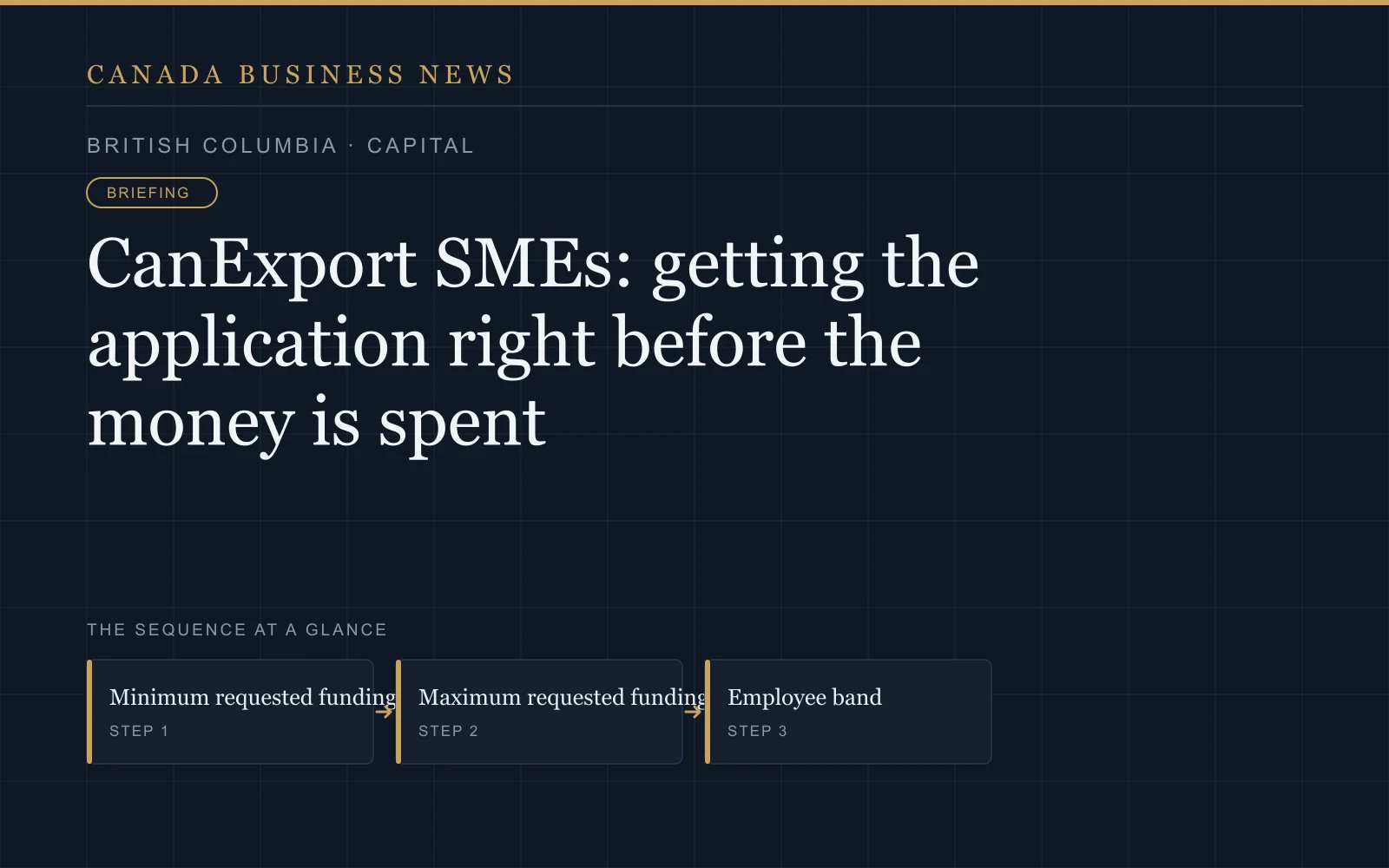
CanExport eligibility gates
Hard limits from the official 2026-27 applicant guide, checked before any drafting.
Lower bound of requested CanExport SMEs funding per project.
Upper bound of requested funding; the program covers up to 50% of eligible costs.
Full-time employee range required for applicant eligibility.
Source basis: Trade Commissioner Service applicant's guide 2026-27
CanExport SMEs exists to share the cost of entering a new international market: travel, trade events, marketing adaptation, market intelligence, and certain advisory work. The current applicant guide sets requested funding between $10,000 and $50,000 and covers up to 50 percent of eligible project costs.
The program's structure rewards firms that plan the market entry first and request funding second, but before spending. Owners who book the trade show, then discover the program, have usually already converted an eligible cost into an ineligible one.
The eligibility gates to check first
The applicant guide draws hard lines: a for-profit incorporated company, limited liability partnership, or cooperative established in Canada, an active CRA business number, between 3 and 500 full-time employees, and declared Canadian revenue between $300,000 and $100 million in the last complete tax year. A firm outside any band should stop and look at other Trade Commissioner Service supports instead of arguing the edge case.
The target market matters too. CanExport funds expansion into markets where the firm has little or no existing sales. Deepening an already-developed market is a different story than opening a new one, and the application should be framed around the new-market test.
Building a project the assessor can approve
Strong applications read like a project plan, not a wish list: one named market, the activities that open it, the cost of each activity, and the result the firm expects to measure. Cost categories should follow the guide's own language so the assessor never has to translate.
Timing is strategy. Applications are assessed against the coming project period, so owners should map the export calendar, the application window, and the cash the firm can front, because CanExport reimburses rather than prepays.
After approval: the discipline that protects the claim
Approved projects live and die on documentation: invoices, boarding passes, event registrations, and deliverables from any advisors. Treat the claim file like a CRA file from day one. Firms that assign one person to keep it current avoid the end-of-project scramble that delays reimbursement.
B.C. exporters can also stack provincial supports where rules allow, and PacifiCan program pages are the right place to confirm what can sit beside a CanExport project without double-funding the same cost.
Government links used for this briefing
These links point to federal, provincial, territorial, municipal, intergovernmental, or official data sources. Readers should confirm current eligibility and deadlines directly with the issuing government before applying.
Official applicant guide setting funding range, cost share, eligibility bands, and eligible activities.
Federal / ProgramPacifiCan funding for businesses and not-for-profitsPacific Economic Development CanadaFederal regional-development programs B.C. exporters can review alongside a CanExport project.
Provincial / ProgramResources and support for businesses and entrepreneurs in B.C.Government of British ColumbiaProvincial business portal for registration, programs, and export-adjacent supports.