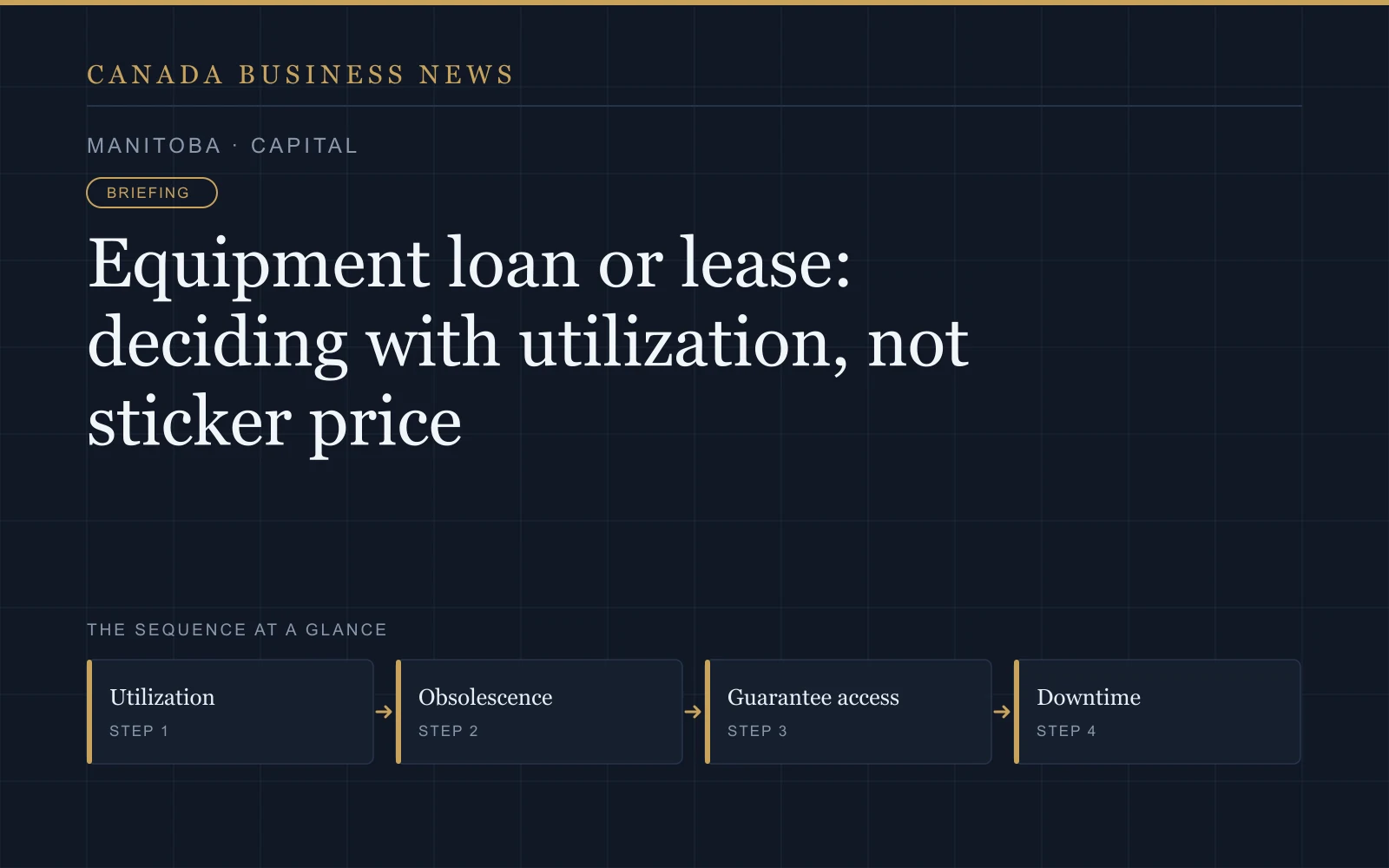
Loan-versus-lease decision matrix
Four tests that decide the structure before price is compared.
High seasonal hours and long asset life favour ownership; parked months favour leasing or renting.
Fast technology cycles push toward lease terms that hand the model-year risk back.
CSBFP and CALA can make a declined purchase financeable for eligible borrowers.
Replacement access and parts timelines can outweigh a cheaper payment.
Source basis: ISED CSBFP and AAFC CALA program terms
The loan-versus-lease debate is usually argued on the wrong field: monthly payment against monthly payment. For a working firm, the decision is really about utilization, obsolescence, and what happens in the week the asset fails.
Manitoba's carriers, contractors, processors, and rural service firms live this decision at scale, because prairie work is seasonal and an idle asset still costs money every month.
The utilization test
Start with honest hours: how many billable hours or loads will this asset run in each season, and what fraction of the year is it parked? High-utilization, long-life assets with slow technology cycles favour ownership. Low-utilization or fast-obsolescence assets favour leasing or renting, because someone else absorbs the idle months and the model-year risk.
Owners should also price the exit. A loan builds equity that can be sold or refinanced; a lease buys flexibility and a predictable handback. Neither is virtuous on its own. The question is which failure would hurt more: being stuck owning the wrong asset, or paying forever for an asset the firm could have owned.
Where federal guarantees change the answer
Two federal programs move the line for eligible firms. The Canada Small Business Financing Program lets lenders finance equipment purchases and improvements with the government sharing default risk. The Canadian Agricultural Loans Act program does the same for farm operations and agricultural co-operatives.
The practical effect is that a purchase a lender would decline conventionally can become financeable, at terms closer to what a larger firm would see. Any operator being pushed toward a lease purely because a conventional loan was declined should ask the same lender about the guarantee programs before signing.
Pricing downtime into the decision
A financed asset that fails mid-season costs three times: the repair, the lost revenue, and the crew standing still. Before signing either structure, owners should know the local repair capacity, the loaner or replacement terms, and the realistic parts timeline for the specific model.
That analysis sometimes flips the decision. A slightly more expensive lease with guaranteed replacement can out-earn a cheaper loan on an asset with a two-week parts queue. Put the downtime scenario in writing and make the dealer respond to it.
Government links used for this briefing
These links point to federal, provincial, territorial, municipal, intergovernmental, or official data sources. Readers should confirm current eligibility and deadlines directly with the issuing government before applying.
Federal loan-guarantee program covering equipment purchases and improvements for eligible small firms.
Federal / ProgramCanadian Agricultural Loans Act ProgramAgriculture and Agri-Food CanadaFederal loan-guarantee program for farmers and agricultural co-operatives, including equipment financing.
Provincial / ProgramBusiness, mining, trade and job creationGovernment of ManitobaProvincial source for Manitoba business and economic-development programs.
Federal / ProgramFunding for businesses in the Prairie provincesPrairies Economic Development CanadaFederal regional-development funding relevant to prairie equipment and productivity projects.