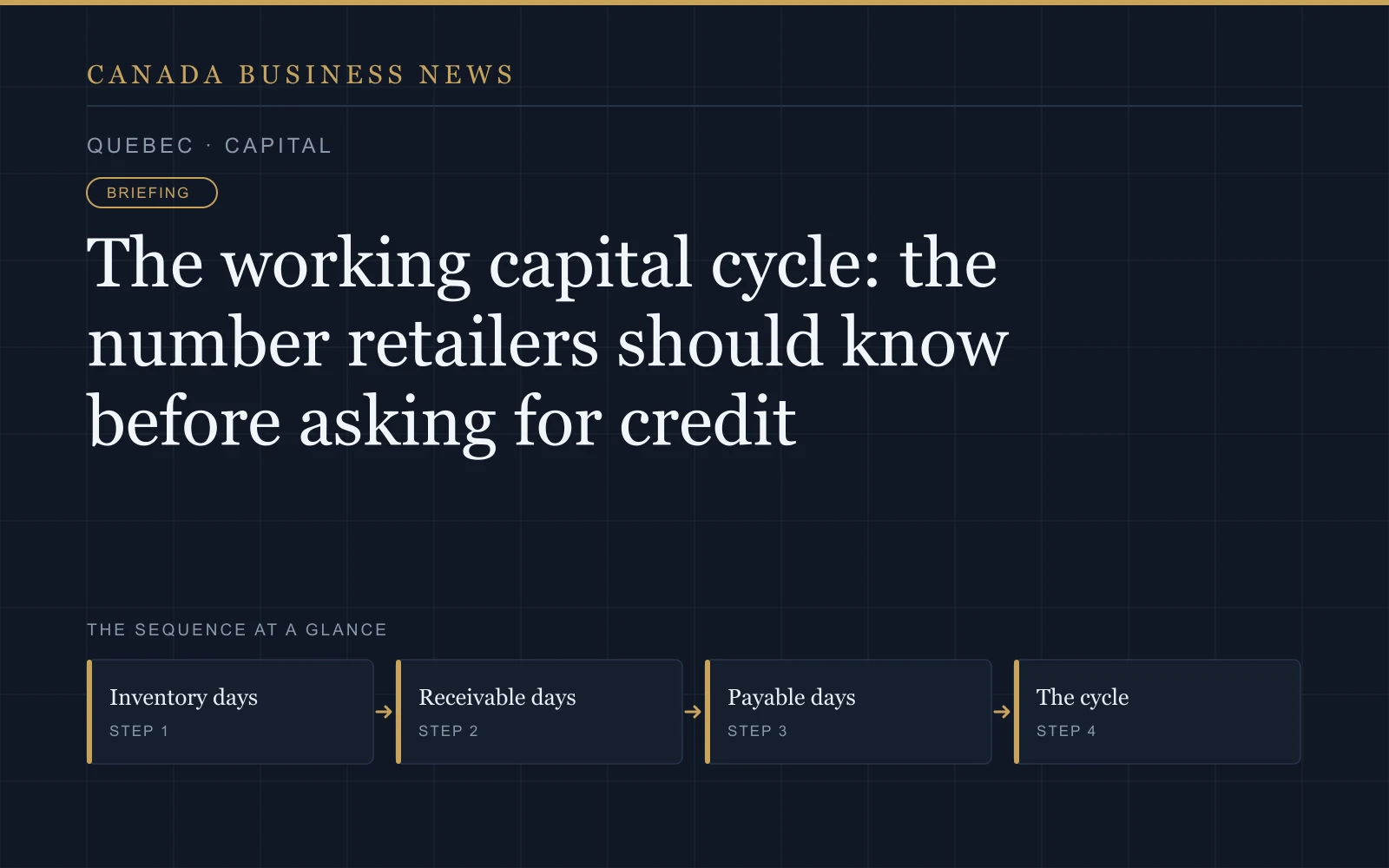
Cash conversion cycle
Three numbers from existing statements combine into the figure lenders actually price.
How long stock sits before it sells; cut the slowest sixth of the assortment first.
How long invoiced customers take to pay; deposits and real terms shorten it.
The terms suppliers actually grant; predictable accounts can ask for seasonal terms.
Inventory plus receivables minus payables: the funding gap a credit request should be sized to.
Source basis: Constructed from standard statements; obligations per Revenu Quebec
Most small retailers can quote yesterday's sales. Far fewer can say how many days pass between paying a supplier and banking the customer's money for the same goods. That gap, the cash conversion cycle, is the quiet number that decides whether a growing quarter feels like success or suffocation.
For Quebec's independent retailers and service firms heading into the fall buying season, measuring the cycle now is the difference between negotiating credit from strength in September and requesting rescue in November.
Measuring the cycle with the books you already have
Three numbers build the cycle. Inventory days: how long stock sits before it sells. Receivable days: how long invoiced customers take to pay, which for card-paying retail is short but for B2B and institutional customers is not. Payable days: how long suppliers actually give you. Inventory days plus receivable days minus payable days is the cycle.
A positive cycle means the firm finances its own shelves; the longer the cycle, the more of the balance sheet is parked in stock and unpaid invoices. Owners do not need perfect costing to start. Even a quarterly estimate from existing statements exposes the trend.
Three levers before borrowing
Shorten inventory days by cutting the slowest sixth of the assortment and reordering winners in smaller, more frequent batches. Shorten receivable days with deposits, card-on-file, and invoice terms that match reality rather than habit. Lengthen payable days by asking key suppliers for seasonal terms in writing, which many grant to accounts that order predictably.
Each lever frees cash without a lender. The point is not to avoid credit; it is to arrive at the lender having already done what credit cannot do.
Turning the cycle into a credit request
A lender hears two very different requests. One is a firm that needs money. The other is a firm whose cycle runs 45 days, whose fall buy adds a known amount of inventory, and which needs a facility sized to that measured gap for a defined window. The second request is easier to approve, and often cheaper.
Federal and provincial supports also assume this discipline. Program pages from ISED and Quebec's business portals are built around defined costs and defined needs, and Revenu Quebec obligations, taxes collected but not yet remitted, must be carved out of any working-capital math before the number is real.
Government links used for this briefing
These links point to federal, provincial, territorial, municipal, intergovernmental, or official data sources. Readers should confirm current eligibility and deadlines directly with the issuing government before applying.
Official Quebec source for the tax obligations that must be carved out of working-capital math.
Federal / ProgramBusiness Benefits FinderGovernment of Canada / Innovation CanadaOfficial gateway for federal supports a retailer can review before seeking credit.
Federal / ProgramCanada Economic Development for Quebec RegionsGovernment of CanadaFederal regional-development agency for Quebec SME funding and guidance.
Official data / EvidenceKey Small Business Statistics 2024Innovation, Science and Economic Development CanadaOfficial SME statistics providing context on small-firm financing conditions.