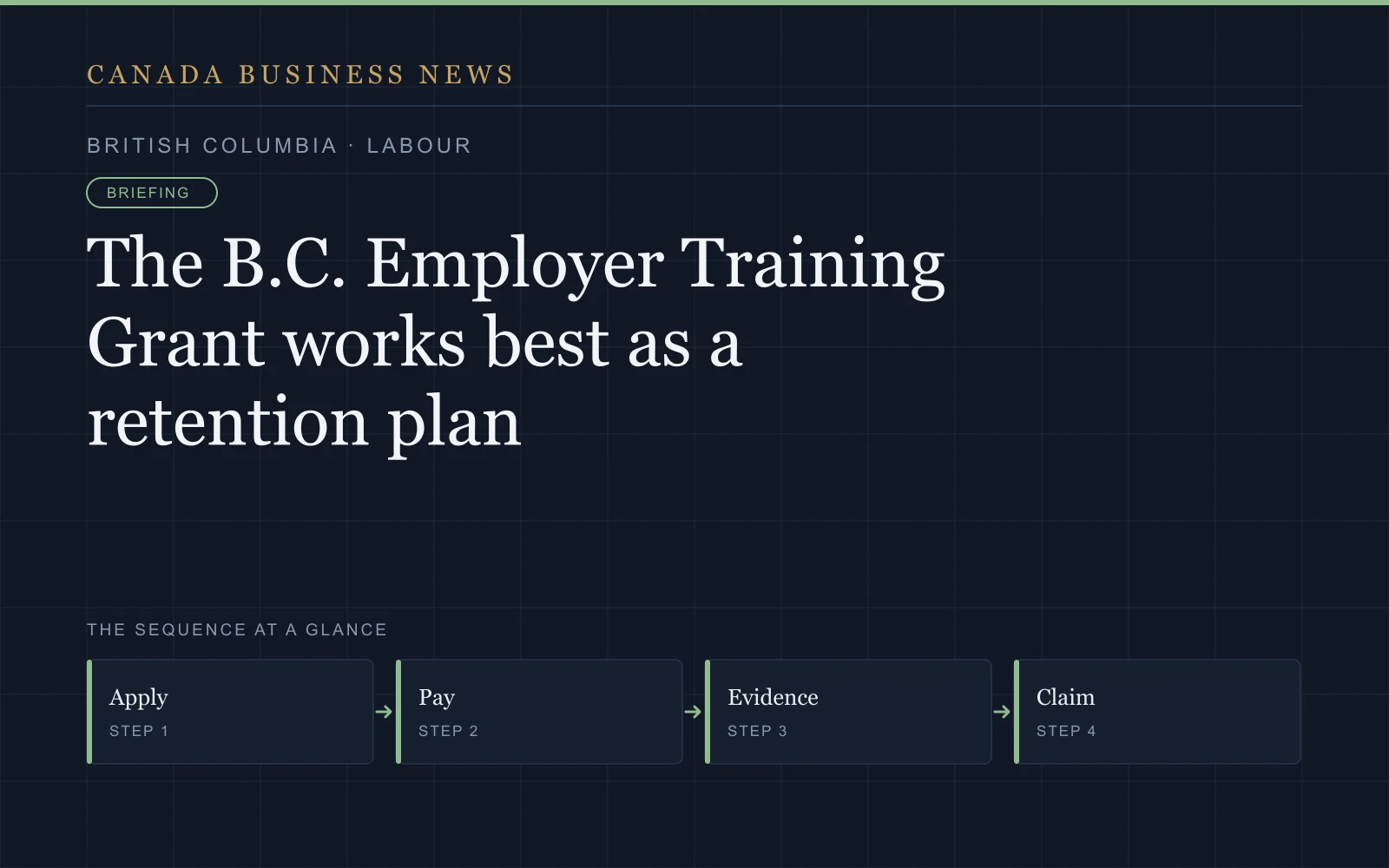
ETG reimbursement flow
The employer fronts the cost; the claim recovers the eligible share.
Before the course starts; late applications are the standard disqualifier.
Employer pays the provider and carries the cost through training.
Collect enrolment, invoices, attendance, and completion as they occur.
Reimbursement of the eligible share after completion, per current stream rules.
Source basis: B.C. Employer Training Grant program page
The B.C. Employer Training Grant reimburses employers for a share of the cost of training current or new employees. The mechanics are simple, but the strategic use is not the course catalogue; it is the retention plan.
Small firms lose people when the role stops growing. A funded training plan that visibly upgrades an employee's role is simultaneously a productivity project and the cheapest retention tool the firm has.
How the money flows
The employer selects the training, applies before the training starts, pays the provider, and claims reimbursement for the eligible share after completion. Streams, cost-share percentages, and per-participant caps are set on the provincial program page, and the application must precede the course start date, which is the mistake that disqualifies otherwise eligible employers.
Because it is reimbursement, the firm carries the cost through the training period. Budget it like any other project cost and treat the grant as recovery, not free tuition.
Building an application that reads as a plan
Strong applications connect the course to a role: what the employee does today, what the training enables, and what changes for the business, a new service line, a certification the market requires, or supervision capacity that lets the firm take larger work. That story also happens to be the truth test: if the course does not change the role, it is probably the wrong course.
Keep enrolment records, invoices, attendance, and completion certificates as they are generated. The claim is documentation, and firms that collect it live never face the end-of-project reconstruction.
Stacking with the rest of the toolkit
Training grants sit naturally beside other supports: PacifiCan programming for productivity projects, and federal tools found through the Business Benefits Finder. The rule against double-funding the same cost applies everywhere, so map each dollar to one program.
For seasonal B.C. operators, shoulder-season training windows convert slow weeks into capability the peak season sells.
Government links used for this briefing
These links point to federal, provincial, territorial, municipal, intergovernmental, or official data sources. Readers should confirm current eligibility and deadlines directly with the issuing government before applying.
Official provincial program page for streams, cost shares, and application requirements.
Federal / ProgramPacifiCan funding for businesses and not-for-profitsPacific Economic Development CanadaFederal regional programs that can sit beside a training plan without double-funding.
Federal / ProgramBusiness Benefits FinderGovernment of Canada / Innovation CanadaOfficial gateway for federal supports to map against training investments.