CSJ calendar reality
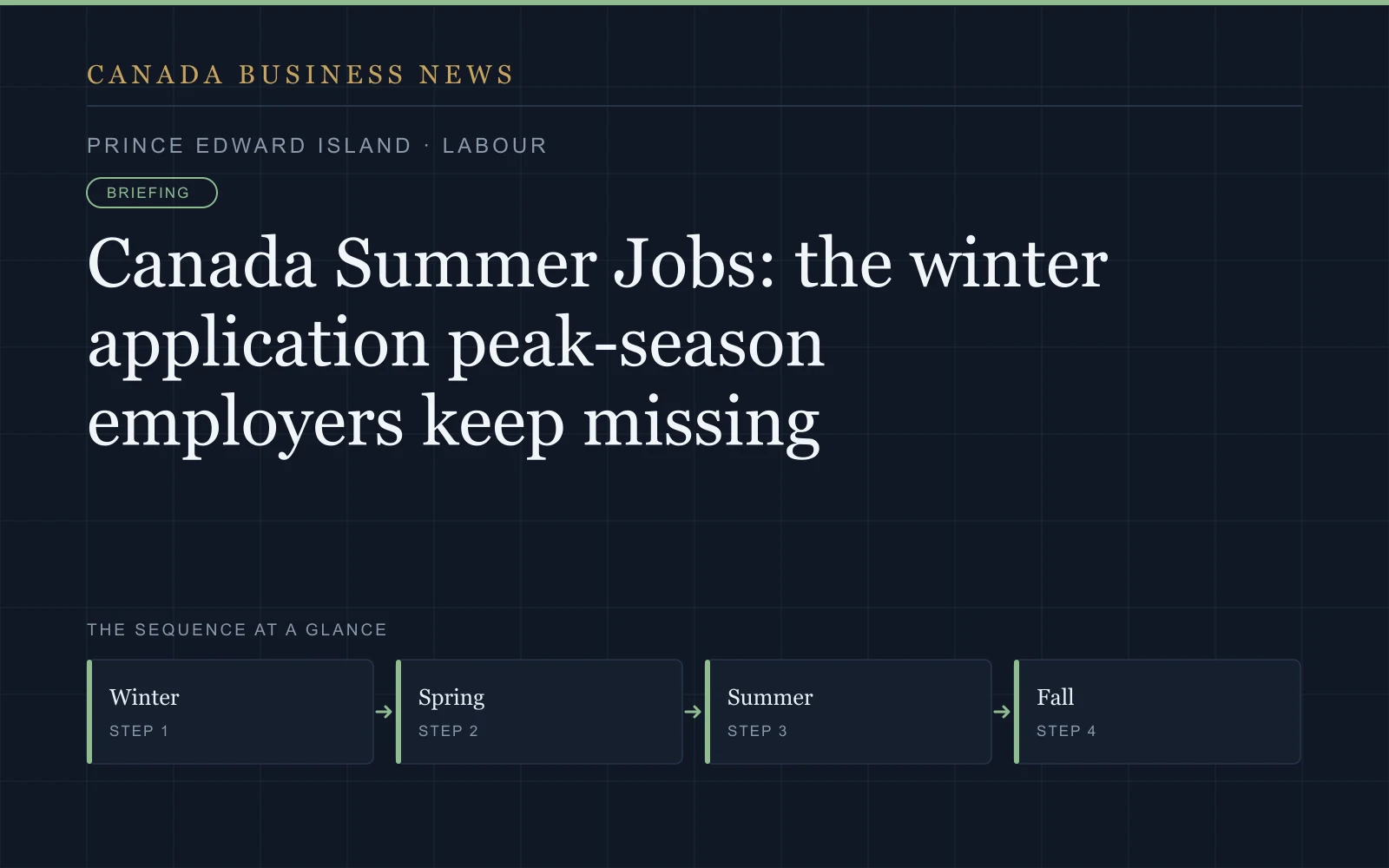
The program's clock runs opposite to the seasonal employer's clock.
Employer application window opens; read current national and local priorities first.
Assessments and approvals; design the supervision and skills plan now.
Placement runs on documented payroll with standards obligations.
Claims reconciled; strong placements become next season's recruiting pipeline.
Source basis: ESDC Canada Summer Jobs program page
Every spring, seasonal employers discover Canada Summer Jobs a few months too late. The program funds summer placements for young workers, but the employer application window opens in the winter, and by the time tourism and trades firms are staffing up, the intake is closed.
For P.E.I. employers whose entire year is compressed into a short season, the subsidy can materially change what a summer crew costs. The edge is purely calendrical: apply when the snow is still on the ground.
What the program funds
Canada Summer Jobs subsidizes wages for placements for youth aged 15 to 30. Private-sector employers with 50 or fewer full-time employees can receive a subsidy calculated against the provincial minimum wage, with not-for-profit employers eligible for a higher share. Exact percentages, durations, and priorities are set per intake, so the current program page governs.
Placements must be real jobs with supervision and skills development, and the annual intake publishes national and local priorities that shape scoring. Reading the current priorities before writing the application is the cheapest scoring gain available.
Designing a role that scores
Applications describe the job, the supervision plan, and the skills the young worker gains. Employers who write a real development arc, what the worker learns in week one versus week eight, and connect the role to community benefit consistently outscore employers who describe generic labour.
Be precise about hours, duration, and supervision names. Vague plans read as risk to assessors, and CSJ assessments are competitive within each riding's budget.
Running the placement properly
An approved placement is still an employment relationship: payroll deductions, provincial employment standards, and safety obligations all apply, and the subsidy is claimed against documented payroll. Set up the payroll records cleanly from day one so the claim is an export, not a reconstruction.
P.E.I. employers can pair CSJ with provincial workforce supports listed on the province's business portal, and a well-run placement often becomes the recruiting pipeline for next season's staff.
Government links used for this briefing
These links point to federal, provincial, territorial, municipal, intergovernmental, or official data sources. Readers should confirm current eligibility and deadlines directly with the issuing government before applying.
Official program page for the wage subsidy, application window, and current intake priorities.
Provincial / ProgramBusiness grants and supportsGovernment of Prince Edward IslandProvincial supports P.E.I. employers can review alongside a CSJ placement.
Federal / CompliancePayrollCanada Revenue AgencyThe payroll obligations that apply to every subsidized placement.