Discount removal plan
The predictable buyer discounts and the two-year sequence that removes them.
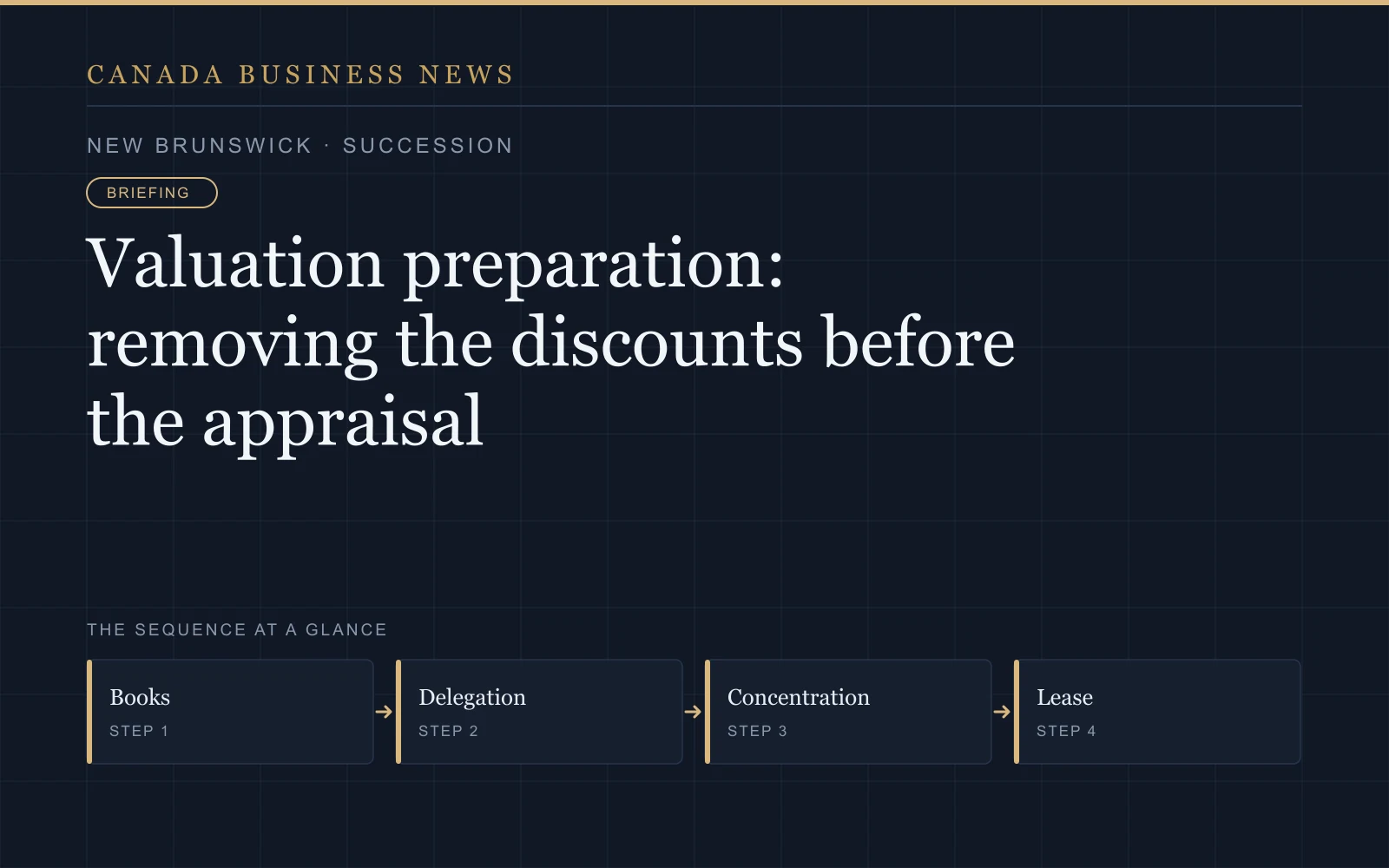
Clean monthly statements a buyer's lender can underwrite without reconstruction.
Customer, supplier, and staff relationships carried by names other than the owner's.
Heaviest customer and supplier dependencies diversified where realistic.
Term and assignment clarity that protects the location's value in a sale.
Source basis: Constructed from CRA and lender underwriting requirements
Owners think about valuation as a number a professional will eventually calculate. Buyers and their lenders think about it as a starting figure minus a list of discounts, and the discounts are predictable: owner dependence, informal records, customer concentration, undocumented processes, and lease uncertainty.
The preparation case is simple: every discount removed before the appraisal is worth multiples of the effort it costs, and in Atlantic Canada's succession-heavy market, prepared businesses stand out to a thin buyer pool.
The discounts buyers actually apply
Owner dependence is the largest: if customers, suppliers, and staff all route through the founder, a buyer is purchasing a job, not a business, and prices it accordingly. Informal books force the buyer to reconstruct true earnings, and every reconstruction is resolved against the seller. Concentration, one customer over a fifth of revenue, one supplier with no alternative, prices in fragility. A short or unclear lease can cap the value of an otherwise strong location business.
None of this is theory to a lender. Financing under programs like the Canada Small Business Financing Program still requires the lender to believe the earnings survive the transition.
The two-year removal plan
Year one: move the books onto clean monthly statements, document the ten core processes, and put names other than the owner's on customer and supplier relationships. Year two: lengthen or clarify the lease, diversify the heaviest concentration where realistic, and let the new management structure produce a full year of results the statements can show.
The sequence matters because buyers weight recent, demonstrated performance. A change made the quarter before listing reads as staging; the same change two years earlier reads as how the business runs.
Preparation as its own return
Every step above, cleaner reporting, documented processes, delegated relationships, a solid lease, also reduces the owner's daily load and the firm's operating risk immediately. Succession preparation is the rare project that pays whether or not the sale happens, and provincial and ACOA advisory supports can offset the professional costs of doing it properly.
Government links used for this briefing
These links point to federal, provincial, territorial, municipal, intergovernmental, or official data sources. Readers should confirm current eligibility and deadlines directly with the issuing government before applying.
Official CRA guidance on the tax dimensions of selling a business.
Federal / ProgramCanada Small Business Financing ProgramInnovation, Science and Economic Development CanadaThe financing program buyer-side lenders work within when purchases include eligible assets.
Federal / ProgramHow can ACOA help me?Atlantic Canada Opportunities AgencyRegional advisory and growth support relevant to succession preparation.
Provincial / ProgramBusiness growth, financing and supportGovernment of New BrunswickProvincial supports for owners preparing businesses for transition.