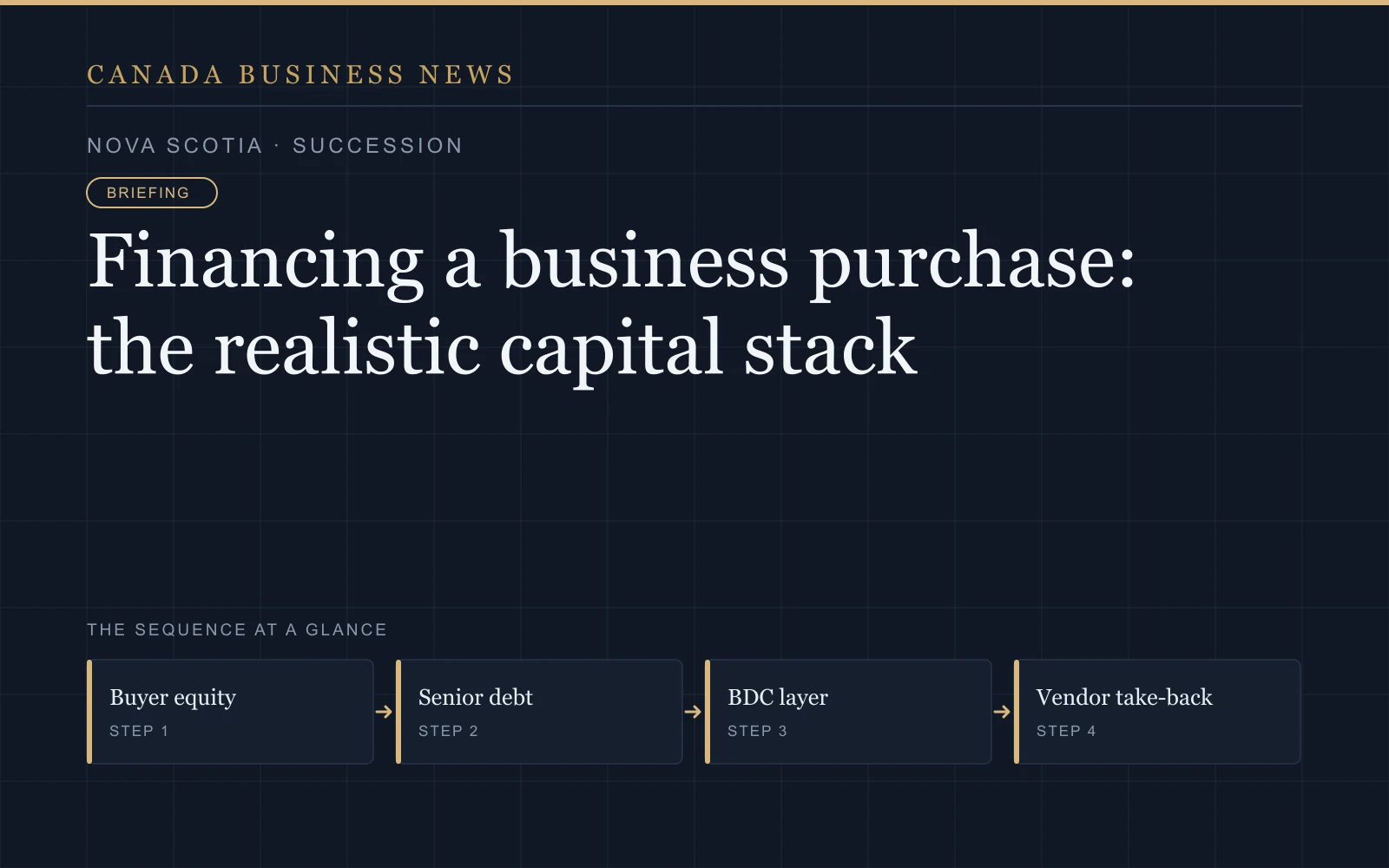
The acquisition capital stack
How small purchases actually close, layer by layer.
The anchor; lenders require the buyer's own capital at risk.
Bank or credit union financing, with CSBFP guarantees on eligible assets.
Development-bank transition financing complementing the senior lender.
Seller financing that bridges valuation gaps and signals confidence.
Source basis: BDC, ISED CSBFP, and standard lender underwriting
The buyer who waits until they can pay cash for a business will never buy one. Small acquisitions in Canada close on a stack: the buyer's equity, senior debt from a lender, often a federal guarantee helping that debt exist, frequently BDC participation, and very often a vendor take-back that keeps the seller invested in the transition.
Understanding how the pieces fit is the difference between an offer a seller takes seriously and a hopeful conversation.
The pieces of the stack
Buyer equity anchors everything; lenders want the buyer's own capital at risk. Senior debt comes from banks and credit unions, and for eligible asset-heavy purchases the Canada Small Business Financing Program guarantee can carry parts a lender would not take alone. BDC, the federal development bank, lends specifically into business transitions and can take positions complementing the senior lender.
The vendor take-back, the seller financing a portion of the price over time, is the stack's most underrated piece. It bridges valuation gaps, and it tells the lender the person who knows the business best is willing to be paid from its future earnings.
What lenders underwrite in an acquisition
The lender is buying the target's cash flow: normalized earnings, durability through transition, and the buyer's capacity to run it. Expect the file to require three years of the target's financials, the purchase agreement's structure, the buyer's experience and net worth, and a transition plan naming how customers and key staff are retained.
This is why the seller's preparation and the buyer's financing are the same project seen from two sides. A prepared business is a financeable business, and financeable businesses sell.
Sequencing the deal
Talk to lenders before the offer, with the target's high-level numbers, so the offer is written inside what debt will support. Build the take-back conversation into negotiation rather than springing it late. Close the working-capital facility with the acquisition, not after it, because the first season under new ownership is when cash is tightest.
Atlantic buyers can add regional programming to the map: ACOA growth support and provincial financing supports can strengthen the post-acquisition investment plan the lender is also evaluating.
Government links used for this briefing
These links point to federal, provincial, territorial, municipal, intergovernmental, or official data sources. Readers should confirm current eligibility and deadlines directly with the issuing government before applying.
The federal development bank that lends into business transitions and acquisitions.
Federal / ProgramCanada Small Business Financing ProgramInnovation, Science and Economic Development CanadaFederal guarantee that can support eligible asset-heavy portions of a purchase.
Federal / ComplianceSelling a businessCanada Revenue AgencyThe seller-side tax framework the deal structure must respect.
Federal / ProgramLooking to grow an existing businessAtlantic Canada Opportunities AgencyRegional support strengthening the post-acquisition investment plan.